
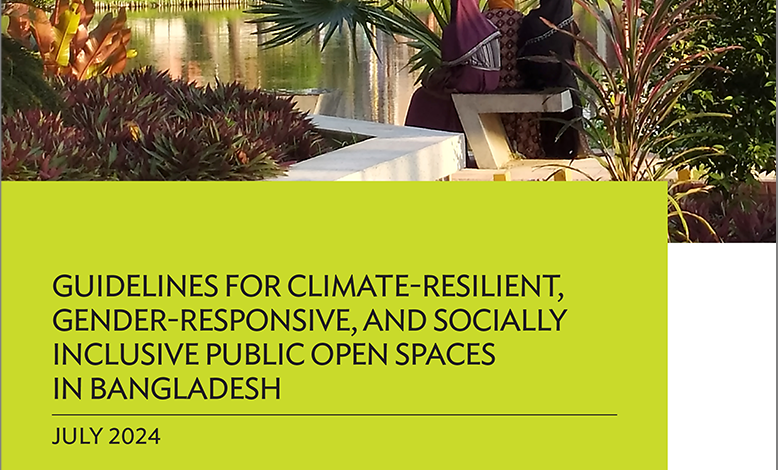
Guidelines for climate-resilient, gender-responsive, and socially inclusive public open spaces in Bangladesh
Public open spaces define the experience of a town or a city. They improve the quality of life for residents (UN-Habitat 2015), particularly the urban poor; increase climate adaptation for regions vulnerable to disasters such as Bangladesh; and support livelihoods. The National Building Code outlines standards to estimate the requirement for public open spaces in urban areas of Bangladesh. There is a dearth of planned public open spaces in cities and towns in the country. The Master Plan addresses this gap by providing a blueprint for adequate public open spaces in the long term. Pourashavas can redesign existing roads, pedestrian pathways, planned organic public open spaces, and underutilized government lands to improve the quality of life for residents. There is limited guidance on the role of public open spaces in climate adaptation in Bangladesh, and the tools to enable access for all, especially women, girls, gender minorities, and people with disabilities. For example, research from larger cities in Bangladesh indicates that while women may be involved in numerous community activities, they may not use open spaces for leisure (Jabeen 2019). Adolescent girls are less likely than their male peers to use parks due to spatial and social factors (Brown, Khan, and Hung, 2021). Public open spaces are often inaccessible for people with disabilities, despite the Rights of Persons with Disabilities Act (2013) (WDDF 2014). Designing public open spaces to increase the presence of different groups of women—young and adolescent girls, pregnant women, elderly women, women with disabilities, resource poor women—can make them inclusive for all. Simultaneously, women’s participation in the decision-making of public open space development can ensure that the barriers and expectations of different groups of women and girls are heard and incorporated from the inception. Moreover, when communities see women representing them capably, it influences norms and perceptions about them as leaders. Resources are required to encourage participation and provide training and support to help more women understand how governance and budgets work and what their rights and duties are as representatives (Brown, Khan, and Hung 2021). Objective Recognizing this need, the Local Government Engineering Department (LGED) has adopted guidelines to create climate-resilient and gender and socially inclusive public open spaces for cities and towns in Bangladesh. These guidelines outline participatory processes to prioritize, design, implement, and maintain public open spaces in coastal towns. It builds on the learnings of emerging good practices in public space design in Bangladesh (photo); the 8th Five-Year Plan (2020–2025) (GED 2020); and the National Adaptation Plan (MoEFCC 2022), and strengthens the sociocultural and livability needs of the Delta Plan 2100 (GED 2020).
source :
https://www.adb.org/publications/guidelines-public-open-spaces-bangladesh


