
Tahukah Anda
History & Evolution of ESG
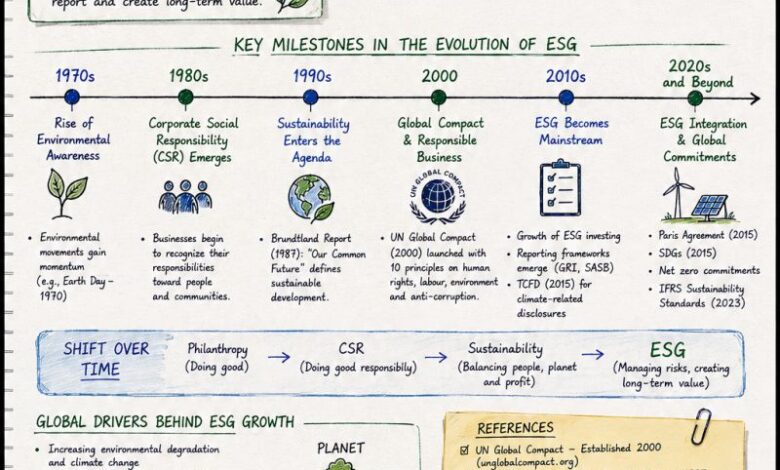
The evolution of Environmental, Social, and Governance (ESG) reflects a fundamental shift in corporate finance: moving from value-driven ethical screening to risk-adjusted value creation. Understanding this historical trajectory reveals how informal corporate philanthropy transformed into a mandatory global reporting architecture.
Historical Timeline: 6 Pivotal Eras of ESG
1. Pre-1970s: Ethical & Socially Responsible Investing (SRI)
- Pioneer Movements: Rooted in religious and ethical avoidance strategies (e.g., Quaker and Methodist investment bans on weapons, alcohol, and gambling).
- Anti-Apartheid Divestment (1960s–1970s): Institutional investors began withdrawing capital from South African businesses to protest racial segregation, demonstrating investor influence on political human rights.
2. 1980s–1990s: Environmental Crisis & Triple Bottom Line
- Brundtland Report (1987): The UN World Commission on Environment and Development defined sustainable development as meeting present needs without compromising future generations.
- Exxon Valdez Oil Spill (1989): Catalyzed the formation of the Ceres network and the subsequent launch of the Global Reporting Initiative (GRI) in 1997 to standardize corporate environmental reporting.
- Triple Bottom Line (1994): John Elkington coined the framework balancing People, Planet, and Profit, moving corporate goals beyond pure shareholder theory.
3. 2000s: The Coining of “ESG” & UN Global Compact
- UN Global Compact (2000): Established 10 principles covering human rights, labor, environment, and anti-corruption for multinational corporations.
- “Who Cares Wins” Report (2004): Co-authored by the UN Global Compact and financial institutions, this report officially introduced the acronym ESG, arguing that incorporating E, S, and G factors leads to better financial returns and risk management.
- Principles for Responsible Investment (PRI) (2006): Launched at the New York Stock Exchange to encourage institutional investors to integrate ESG factors into capital allocation.
4. 2010s: Global Commitments & Strategic Integration
- UN Sustainable Development Goals (2015): Adopted 17 global goals (SDGs) providing a shared blueprint for peace and prosperity, framing corporate sustainability targets.
- Paris Agreement (COP21, 2015): Binding international treaty aiming to limit global warming to well below $2^\circ\text{C}$ (preferably $1.5^\circ\text{C}$), establishing decarbonization mandates.
- TCFD Formation (2015): The Financial Stability Board created the Task Force on Climate-related Financial Disclosures, establishing climate risk as a core financial concern.
5. 2020s: Standardization, Double Materiality & Mandatory Disclosures
- ISSB Launch (2021): The International Financial Reporting Standards (IFRS) Foundation established the International Sustainability Standards Board (ISSB), releasing IFRS S1 and S2 to unify global baseline disclosures.
- Regulatory Enforcement (2024–2026): Transition from voluntary reporting to mandatory compliance through frameworks like the EU Corporate Sustainability Reporting Directive (CSRD) and global climate disclosure rules.
Evolution Comparison: SRI vs. CSR vs. Modern ESG
| Dimension | Socially Responsible Investing (SRI) | Corporate Social Responsibility (CSR) | Modern Integrated ESG |
| Primary Approach | Negative screening (exclusionary) | Voluntary philanthropy & PR | Quantified risk management & strategy |
| Materiality Focus | Moral & ethical values | Societal impact & corporate citizenship | Double Materiality (Financial + Impact) |
| Governance Role | Investor-led exclusions | PR & Marketing department | Board of Directors & C-Suite oversight |
| Standardization | Low / Ad-hoc | Qualitative / Narrative | High (IFRS/ISSB, CSRD, GRI, SASB) |
Strategic Value Impact
[Ethical Screening (SRI)] ──> [Corporate Reputation (CSR)] ──> [Financial Risk & Value Integration (ESG)]
Understanding ESG’s evolution shows that modern sustainability reporting is no longer about public relations it is a core requirement for capital access and enterprise resilience.


