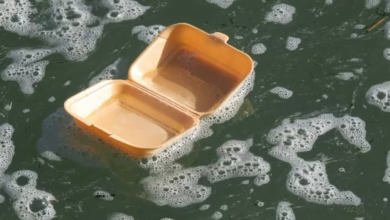
How long does plastic take to Decompose?

The lifespan of a single-use plastic item is a study in contradictions: we use it for a few minutes, yet it lingers on our planet for centuries. While “decomposition” suggests a natural return to the earth, plastic never truly disappears; it simply breaks down into smaller and smaller “microplastics” that infiltrate our soil, water, and even our own bodies.
Here is a breakdown of how our daily choices echo through time, and how we can pivot toward a more sustainable future.
The Longevity of Waste: Decomposition Timelines
To understand the impact of “small” habits, we must look at the persistence of the materials we discard.
| Item | Estimated Decomposition Time | Impact Note |
| Plastic Bag | 20 Years | Often ends up in oceans, mistaken for food by marine life. |
| Coffee Cup | 30 Years | Plastic linings make these difficult to recycle. |
| Straw | 200 Years | Small size makes them high-risk for wildlife ingestion. |
| Plastic Bottle | 450 Years | One of the most common pollutants in global waterways. |
| Fishing Line | 600 Years | Designed for durability, causing “ghost fishing” for centuries. |
Beyond the Statistics: The Power of Behavioral Shifts
Climate change is often framed as a battle of technology and policy, but at its heart, it is a human story. Our collective behavior is the most powerful “technology” we have to drive immediate emissions reductions.
Here is how individual actions create a ripple effect:
- Mindful Consumption: By choosing products with minimal packaging or opting for repair over replacement, you reduce the demand for the carbon-intensive manufacturing of new plastics.
- The Diet-Climate Link: Shifting toward more plant-based meals isn’t just a personal health choice; it reduces the vast amounts of methane and land use associated with industrial livestock.
- Energy Intelligence: Small habits unplugging “vampire” electronics or adjusting thermostats scale up to significant pressure relief on the national energy grid.
- Active Mobility: Walking or cycling doesn’t just cut tailpipe emissions; it reshapes our cities to be more human-centric and less car-dependent.
The Ripple Effect: Individual Action as a Catalyst
It is a common misconception that individual actions are “too small” to matter. In reality, personal habits serve as the cultural engine for systemic change:
- Market Signals: When billions choose sustainable brands, corporations are forced to innovate or lose market share.
- Social Norms: Sustainable behavior is contagious. When neighbors see solar panels or reusable bags, the “unconventional” becomes the “standard.”
- Political Will: Governments are more likely to pass ambitious climate legislation when they see a constituency already living those values.
Insight: We aren’t just “consumers” we are influencers of the global economy. Every time you refuse a single use plastic bottle, you are casting a vote for the kind of world you want to inhabit 450 years from now.
source: