
Issue 27: resilience and regeneration II
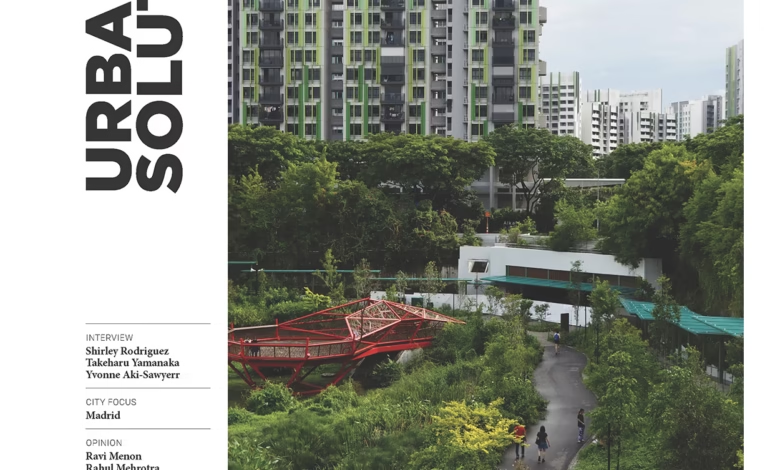
Unpacking Resilience and Regeneration (Issue 27)
Issue 27 of the series isn’t just a report it’s a deep dive into the practical revolution of design thinking. Moving past the defensive posture of “sustainability,” this issue explores the dynamic potential of Regenerative Design, providing the necessary roadmap to transition from theory (explored in Issue 25) to impactful, resilient reality.
The Challenge: Operationalizing Regeneration
The core focus of Issue 27 is the critical transition from understanding the concept of regeneration to making it operational. Regenerative design aims not just to minimize harm, but to actively improve systems be they ecological, social, or economic. This transition presents significant challenges:
- Complexity: Regenerative projects inherently involve complex, interconnected systems, requiring multi-disciplinary collaboration and holistic metrics that traditional design workflows often lack.
- Scale and Investment: Implementing regenerative practices often demands upfront investment and patience, as ecological and social returns may not materialize on a quarterly basis.
The Opportunity: Unpacking Enablers and Outcomes
Issue 27 unpacks the enablers that are successfully driving the integration of regenerative principles and the measurable outcomes that result in genuine resilience:
Enablers of Integration
This section explores the crucial mechanisms that facilitate the shift toward regenerative practices:
- Holistic Metrics: Developing performance indicators that go beyond carbon footprint and energy use to include factors like soil health, biodiversity increase, community vitality, and resource cycling.
- Systemic Partnerships: Identifying and leveraging collaboration across the entire value chain from finance and policy to local communities and materials suppliers.
- Adaptive Governance: Implementing flexible organizational and policy frameworks that allow projects to learn and evolve based on real-time ecological feedback.
Outcomes that Build Resilience
The goal of this transition is ultimately to build resilience the ability of a system to absorb shocks and adapt to change. Issue 27 highlights specific outcomes:
- Ecological Health: Measurable increases in local biodiversity and ecosystem services (e.g., enhanced water retention, carbon sequestration).
- Economic Viability: Projects that reduce long-term operational costs by harnessing natural processes (e.g., bio-remediation, passive heating/cooling).
- Social Capital: Strengthened community connections, increased local self-sufficiency, and improved equity through design that actively supports local inhabitants.
Issue 27 serves as the essential guidebook for practitioners, policymakers, and investors ready to embrace design that heals, not just sustains. It argues that by deliberately pursuing regenerative enablers, we move from simply protecting against future threats to actively creating a more robust, thriving world.
source:
https://knowledgehub.clc.gov.sg/publications-library/issue-27-resilience-and-regeneration-ii/


