Power from the ocean
How Wave Energy is Charting the Next Frontier of Renewable Infrastructure
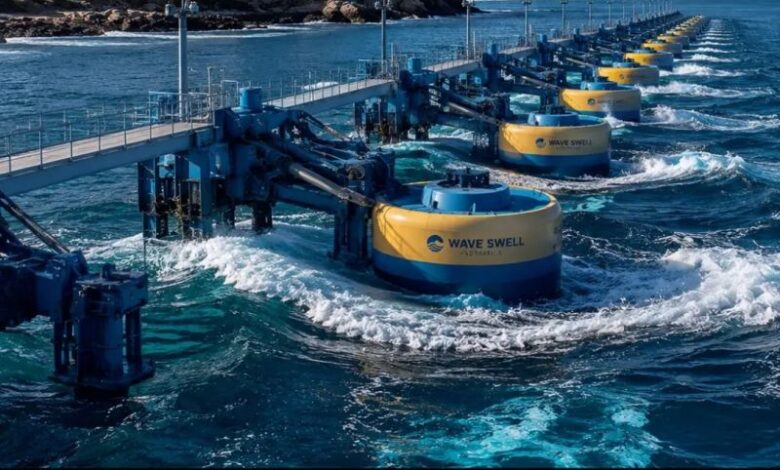
While solar panels and wind turbines dominate the current green energy landscape, the world’s oceans are emerging as the next major arena for utility-scale decarbonization. With its vast, high-energy coastlines, nations like Australia are shifting from theoretical engineering to deploying commercial-scale wave energy systems that convert marine kinetic energy into grid-ready clean electricity.
How it Works, Capturing the Motion of the Ocean
Wave energy converter (WEC) technologies capture the mechanical energy generated by wind blowing across the surface of the water. Unlike tidal energy (which relies on gravitational pull), wave energy utilizes the continuous, orbital movement of water particles.
Engineers deploy several distinct archetypes of technology to harvest this power:
- Point Absorbers: Floating buoy structures that move up and down with the waves. This relative motion drives a hydraulic pump or direct-drive generator inside the unit, converting kinetic energy into electricity transmitted via subsea cables.
- Oscillating Water Columns (OWC): Partially submerged, hollow structures open to the sea below. As waves rise and fall inside the chamber, they trap and compress air, forcing it through an air turbine to spin a generator.
- Attenuators: Multi-segment floating structures oriented parallel to the direction of the waves. The flexing motion at the joints between segments as the wave passes is harnessed by hydraulic rams to drive generators.
6 Strategic Advantages of Wave Energy Infrastructure
Integrating ocean-derived energy into national power grids provides distinct structural and ecological benefits that address the limitations of land-based renewables:
- Continuous Baseload Generation: Unlike solar (dependent on daylight) and wind (dependent on atmospheric shifts), ocean waves are nearly constant, generating electricity 24/7.
- High Predictability: Swell patterns can be accurately modeled and forecast days in advance using satellite and meteorological data, allowing grid operators to balance supply and demand seamlessly.
- Superior Energy Density: Water is roughly 800 times denser than air. This physical property means ocean currents and waves pack far more kinetic energy per square meter than wind, enabling smaller physical footprints for equivalent power yields.
- Proximity to Coastal Hubs: Over 40% of the global population lives within 100 kilometers of a coastline. Generating power just offshore minimizes the need for massive, expensive long-distance inland transmission lines.
- Co-Generation Potential (Desalination): The mechanical pressure generated by wave energy devices can be piped directly to shore to drive reverse-osmosis desalination plants, producing clean drinking water without drawing electricity from the main grid.
- Grid Diversification: Relying solely on solar and wind leaves grids vulnerable to weather-induced dry spells. Ocean power diversifies the clean energy portfolio, building overall grid resilience.
                       [ WIND OVER OCEAN SURFACE ]
                                    │
                                    ▼
                        [ KINETIC WAVE MOVEMENT ]
                                    │
       ┌────────────────────────────┼────────────────────────────┐
       ▼                            ▼                            ▼
[ Point Absorbers ]       [ Oscillating Columns ]         [ Attenuators ]
(Mechanical Buoyancy)        (Air Compression)          (Joint Flexing)
       │                            │                            │
       └────────────────────────────┬────────────────────────────┘
                                    ▼
                         [ TURBINE / GENERATOR ]
                                    │
                                    ▼
                        [ UNDERWATER SUBSEA CABLE ]
                                    │
                                    ▼
                         [ ONSHORE POWER GRID ]
Key Challenges to Commercial Scaling
Despite its immense potential, the wave energy industry is actively navigating technical hurdles before achieving widespread commercial adoption:
- Survivability: Devices must withstand hostile marine environments, including saltwater corrosion, biofouling (barnacle growth), and extreme mechanical stress from severe storms.
- Levelized Cost of Energy (LCOE): Due to the early stage of supply chains, manufacturing and deploying offshore wave arrays is currently more expensive per megawatt-hour than mature technologies like solar PV and onshore wind.
- Marine Eco-Management: Projects require extensive environmental impact assessments to ensure subsea cables, anchors, and moving parts do not disrupt local marine habitats or migration routes.
As global climate targets demand deeper cuts to greenhouse gas emissions, ocean energy represents the missing link in a completely fossil-free energy mix. By shifting investment toward marine engineering, coastal nations can transform their shorelines from frontiers vulnerable to climate change into resilient, self-sustaining energy hubs.