Resources, conservation & recycling
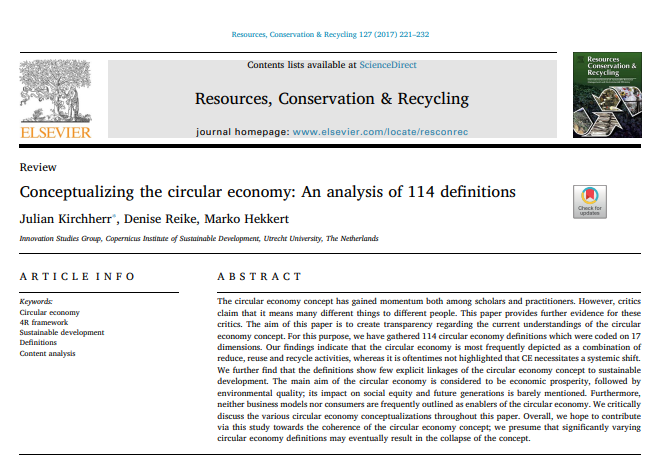
The circular economy (CE) concept is trending both among scholars and practitioners. This is indicated by the rapid growth of peer-reviewed articles on CE: More than 100 articles were published on the topic in 2016, compared to only about 30 articles in 2014 (Geissdoerfer et al., 2017). On the other hand, many consultancy reports have been published on the topic recently (with consultancies attempting to signal
expertise on trending topics to clients via such reports (Kipping and Clark, 2012)). For instance, the major consulting firms Accenture, Deloitte, EY and McKinsey & Company all have published on CE in the past
two years (Gartner, 2016; Hannon et al., 2016; Lacy et al., 2015; Hestin et al., 2016; EY, 2015).
The CE concept is of great interest to both scholars and practitioners because it is viewed as an operationalization for businesses to implement the much-discussed concept of sustainable development
(Ghisellini et al., 2016; Murray et al., 2017). The latter concept has been called too vague to be implementable and has thus started to lose momentum (van den Brande et al., 2011; Peltonen 2017, p.2 ff.) with Naudé (2011, p.352) even calling it a “theoretical dream [rather than] implementable reality” and Engelman (2013, p.3) writing that “we live today in an age of ‘sustainababble’, a cacophonous profusion of uses of the world ‘sustainable [development]’ to mean anything from environmentally better to cool”. Notable concepts also supposed to operationalize sustainable development for businesses are the green
economy and green growth concepts (UNEP, 2011; OECD, 2016), whereas the CE concept is argued to be the one with most traction these days (Ellen MacArthur Foundation, 2014; EY, 2015).
A concept with so much traction is usually employed by various stakeholders. These can blur the concept since they frequently operate in significantly different worlds of thought (Gladek, 2017; de Vries and
Petersen, 2009). Blurriness has been raised as a criticism against concepts such as the green economy one (Loiseau et al., 2016) and it has also been raised against CE in various CE review articles we identified
(Ghisellini et al., 2016; Lieder and Rashid 2016; Blomsma and Brennan, 2017; Sauvé et al., 2016; Murray et al., 2017; Geissdoerfer et al., 2017; Lewandowski, 2016; further details in Table 1) and beyond. For instance, Lieder and Rashid (2016, p.37) point out that “there are various possibilities for defining [CE]”, while Yuan et al. (2008, p.5) write that “there is no commonly accepted definition of [CE]”. However, not a
single study until now, as far as we are aware, has comprehensively and systematically investigated CE definitions. Yet it is both of academic and practical relevance to comprehensively and systematically investigate CE definitions which we view as an operationalization of CE understandings throughout this paper (further discussed in Section 2). After all, a concept with various understandings may ultimately collapse or remain in a deadlock due to permanent conceptual contention (Hirsch and Levin, 1999; Bocken et al., 2017; Blomsma and Brennan, 2017). Meanwhile, further theoretical development of the concept can help cohere it and thus circumvent this (Hirsch and Levin, 1999; Blomsma and Brennan, 2017).
This theoretical development requires, as a first step, transparency regarding current understandings of the concept in the discourse (Hirsch and Levin, 1999; Blomsma and Brennan, 2017). The aim of this paper is to provide this transparency. Hence, the research question addressed in this paper is: What are current understandings of the CE concept among scholars and practitioners? The remainder of this paper is organized as follows. Section 2 outlines methods adopted (including a description of our coding frame). Meanwhile, Section 3 presents and discusses the results of our analysis
of 114 CE definitions. Our argument is summarized in Section.
source: