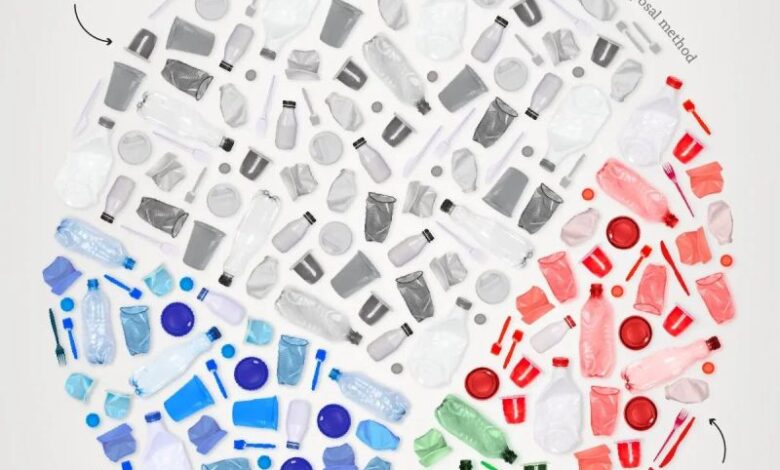
Sorting the world’s plastic
The Trillion-Dollar Battleground of the Next Industrial Revolution
Every day, the global economy relies on a quiet, comfortable myth: that if you put plastic into a blue bin, it magically transforms back into a useful product.
The numbers tell a far more brutal story. Globally, only 9% of our plastic waste is ever recycled. The other 91% is buried in landfills (49%), dumped into ecosystems (22%), or incinerated into toxic ash (19%).
For every 100 plastic items we manufacture, 91 are a one-way ticket to pollution.
Why is this failure rate so catastrophic? It isn’t a lack of goodwill, and it isn’t a lack of demand for recycled materials. It is a sorting crisis. To a machine or a human eye, a clear PET water bottle, a clear PVC blister pack, and a clear PLA bioplastic cup look almost identical. But melt them together, and you don’t get a new product you get a ruined, structurally useless soup.
The circular economy doesn’t have a manufacturing problem. It has an intelligence problem.
The Molecular Chaos of Modern Trash
To understand why sorting is the ultimate bottleneck, we have to look at the sheer diversity of what we throw away. Modern packaging is an intricate mix of distinct polymers, each requiring completely different processing.
       [ THE CHAOTIC WASTE STREAM ]
                     │
    ┌────────────────┼────────────────┐
    ▼                ▼                ▼
[ PET (#1) ]    [ HDPE (#2) ]   [ PVC (#3) ] ...and 4 more major types.
 (Soda/Water)    (Milk Jugs)     (Blister Packs)
    │                │                │
    └────────────────┴────────────────┴── Only when perfectly isolated
                                           can these become valuable assets.
If even a tiny fraction of PVC contaminates a batch of PET, the entire run is ruined. Because human hands and mechanical screens cannot handle this molecular complexity at scale, billions of dollars worth of refined hydrocarbons are dumped into landfills every hour.
The Rise of Cognitive Infrastructure
The countries and companies that dominate the next decade won’t simply build bigger landfills or plead with consumers to read recycling labels. They will conquer the sorting bottleneck using an advanced tech stack:
- Computer Vision & Deep Learning: Industrial conveyor belts are being equipped with high-speed cameras trained on millions of images. These AI systems can identify a specific brand, a specific polymer type, and even differentiate between a food-grade container and a chemical bottle in milliseconds.
- Hyperspectral & NIR Fingerprinting: Near-Infrared (NIR) sensors read the unique optical “signature” of different plastics. By analyzing how light bounces off an object, the system instantly decodes its chemical composition, allowing automated air jets to blast the item into its precise category.
- Robotic Sorting Matrices: Delta robots powered by machine learning can execute up to 80 picks per minute—far exceeding human speed and accuracy relentlessly pulling pure material fractions out of chaotic trash streams.
Trash is Stranded Capital
We have spent decades viewing waste as an environmental chore something to be hidden, buried, or burned. That is a massive failure of imagination.
Our trash heaps are not garbage; they are above-ground mines of highly refined, high-energy materials. The greatest economic opportunity of our generation lies in building the intelligence required to reclaim them.
The question is no longer “How do we dispose of our plastic?” It is “How fast can we sort it?” The future belongs to those who stop seeing a waste management crisis and start seeing the ultimate hardware and software challenge of the 21st century.
Why this angle hits differently:
- It diagnoses the specific pain point: Instead of a generic “save the planet” message, it explains why recycling fails (polymer cross-contamination), making the reader feel like they are getting inside industry knowledge.
- It uses technical, high-value vocabulary: Terms like “cognitive infrastructure,” “hyperspectral fingerprinting,” and “stranded capital” frame this as a high-tech frontier rather than a sanitation issue.
- The visual diagram frames the challenge: The text-based flowchart cleanly visualizes the chaos of the waste stream and the absolute necessity of isolation, setting up the technological solutions beautifully.
source:
https://www.linkedin.com/feed/update/urn:li:activity:7476904078464413696