Sustainability, ESG, CSR and SDG
Decoding the Jargon: Sustainability, ESG, CSR, and SDGs a Strategy Guide
The corporate world is drowning in acronyms, and when it comes to responsible business, the terms Sustainability, ESG, CSR, and SDG are often tossed around as synonyms. This confusion isn’t just semantics; it’s a strategic liability. Truly understanding the difference between these four concepts is crucial for managing risk, attracting capital, ensuring compliance, and delivering genuine, measurable impact.
Let’s move beyond the simple definitions and explore how these concepts fit together as a hierarchy of purpose and action.
1. Sustainability: The Guiding Philosophy
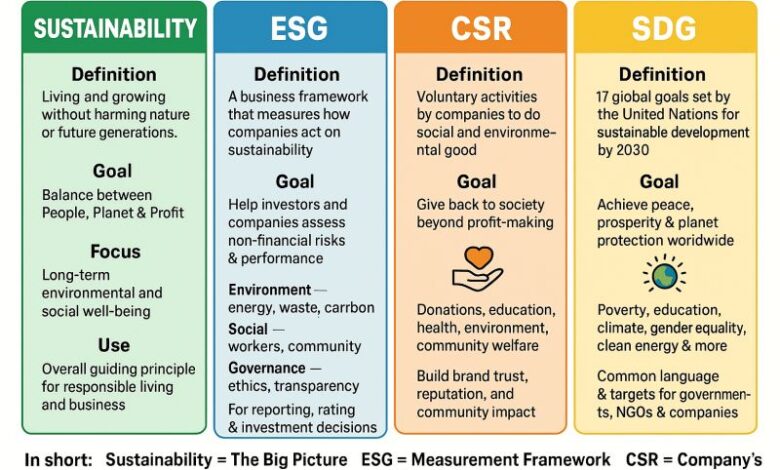
Sustainability is the highest-level concept the fundamental philosophy that underpins all others.
- Meaning: It’s the long-term pursuit of a balance that ensures the well-being of the Planet, People, and Profit (the Triple Bottom Line).
- Focus: It’s about building a business model that can thrive indefinitely without depleting natural or human resources. It answers the question: Is our business model fit for the future?
- The Difference: Sustainability is the destination. It’s the overarching goal of a stable, long-term operating environment. Everything else is a tool to get there.
2. ESG: The Measurable Framework
ESG (Environmental, Social, and Governance) takes the broad philosophical goals of Sustainability and translates them into measurable, quantifiable criteria. This is the language of modern finance and risk management.
- Meaning: A set of criteria used by investors, lenders, and rating agencies to evaluate a company’s non-financial risks and long-term value.
- Focus Areas: ESG answers the question: How do we measure and manage the non-financial risks relevant to our investors?
- E (Environmental): Climate action, resource use, pollution, and waste.
- S (Social): Labor practices, diversity and inclusion, human rights, and community relations.
- G (Governance): Board structure, executive compensation, ethics, anti-corruption, and transparency.
- The Difference: ESG is the reporting and risk tool. It’s how the financial market quantifies a company’s performance against its sustainability risks. Sustainability is why you act; ESG is how you prove it.
3. CSR: The Voluntary Contribution
CSR (Corporate Social Responsibility) represents the company’s voluntary, often philanthropic, actions aimed at benefiting society.
- Meaning: Actions a company chooses to perform often disconnected from its core operations—to give back to the community and build goodwill.
- Focus: Donations, employee volunteer programs, charitable giving, and community sponsorships. It answers the question: What good can we do for society outside of our core business?
- The Difference: CSR tends to be extrinsic and discretionary (e.g., donating $10,000 to a local school). ESG is intrinsic and material to the business’s long-term operations (e.g., changing the supply chain to reduce carbon emissions and operational risk). CSR builds brand trust; ESG secures long-term capital.
4. SDGs: The Global Roadmap
The Sustainable Development Goals (SDGs) are a universal call to action established by the United Nations.
- Meaning: 17 Global Goals agreed upon by member states in 2015, designed to achieve a better and more sustainable future for all by 2030.
- Focus: Specific, interconnected global challenges like ending poverty (SDG 1), ensuring clean water (SDG 6), and climate action (SDG 13). They answer the question: Which global priorities do our actions support?
- The Difference: SDGs are the global roadmap and a framework for alignment. A company might use the SDG framework to articulate which global problems its ESG strategy is trying to solve.
Strategic Synthesis: Making It Work
A high-impact business strategy requires these four concepts to work together:
- Start with the Sustainability philosophy.
- Align your core operations with the global SDG priorities (e.g., focus on SDG 7: Affordable and Clean Energy).
- Implement and measure your performance using the ESG framework (e.g., report on the $E$ metric of renewable energy usage).
- Support local communities through CSR initiatives that complement your mission.
source: