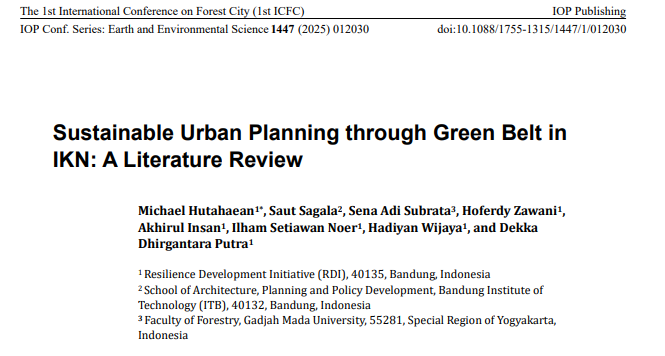
Sustainable urban planning through green belt in IKN: a literature review
The designation of IKN as Indonesia’s new capital city represents a crucial turning point in urban
planning and environmental management. This strategic move, driven by the need to alleviate
demographic pressures on Jakarta and promote equitable economic growth throughout the
archipelago, presents a unique opportunity. Additionally, the abundant forest resources in IKN
present a unique opportunity to integrate the forest city concept into urban development. This
concept involves preserving and conserving natural resources, environmental sustainability, and
forest integrity, all aimed at fostering a harmonious balance between urban development and
environment preservation.
The anticipated urbanization linked to the capital’s relocation carries considerable environmental risks, particularly the risk of urban sprawl. This refers to the uncontrolled spread of urban development into adjacent rural areas, which could endanger the local biodiversity.
Therefore, the strategic implementation of a green belt is proposed to address these challenges
and serve as a foundation for achieving sustainable urban planning. This approach is designed as
a physical buffer to prevent sprawl and control urban expansion.
Moreover, the co-benefits of the green belt extend towards aiding the achievement of net zero targets and enhancing biodiversity conservation, aligning with the goals of the Nusantara Net Zero Strategy 2045 and the global environmental commitments set forth in the Kunming-Montreal Global Biodiversity
Framework. The term “net zero” refers to a strategy aimed at reducing greenhouse gas emissions
to counteract global warming.
Globally, research has recognised green belt as effective urban planning tools that provide
substantial environmental, social, and economic benefits. Examples from cities like London, Sa o
Paulo, and Melbourne illustrate the role of green belts in managing urban growth, safeguarding
natural habitats, and enhancing the sustainability of urban areas. This broader range of benefits
highlights the importance of green belt in contemporary urban planning and supports their
inclusion as a central component of sustainable urban planning strategies. This paper conducts a
thorough examination of IKN’s existing forest conditions, green belt potential, and relevant policy
frameworks to offer a comprehensive analysis of how green belts could enhance IKN’s sustainable
urban planning. Furthermore, this study aims to provide actionable insights and
recommendations for policymakers involved in developing IKN, ensuring a sustainable urban
future.
source :
https://iopscience.iop.org/article/10.1088/1755-1315/1447/1/012030