
The largest and most influential carbon project developers in the world (2026)
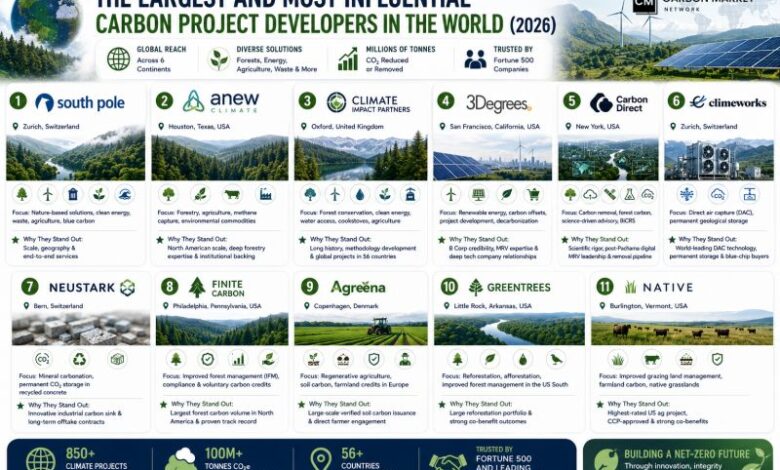
The Architects of Net Zero: Mapping the Carbon Project Superpowers of 2026
For years, carbon project development was the fringe territory of eco-entrepreneurs and niche conservationists. Today, it is an institutional-grade global industry moving billions of dollars.
As corporate climate targets face unprecedented legal and regulatory audits under new global disclosure laws, the market is undergoing a brutal flight to quality. Buying a carbon credit is no longer just about checking a box; it is about defending an environmental balance sheet to skeptical auditors, boards, and regulators.
The developers shaping the next chapter of this market are no longer generalists. They are deep tech pioneers, institutional asset managers, and advanced ecological engineers.
To understand who is actually positioned to dominate, we have to look at the market through its four major operational theaters.
1. The Legacy Powerhouses (AUM & Ecosystem Scale)
These are the institutional titans with diversified global pipelines. They survive by acting as one-stop shops for Fortune 500 corporations needing multi-million-tonne portfolios.
- South Pole: Operating across over 50 nations, they remain a global blueprint for carbon financing, combining vast nature-based pipelines with comprehensive corporate decarbonization advisory.
- Anew Climate & Finite Carbon: Backed by heavy institutional capital (like TPG Rise), Anew and its partner ecosystem form a massive environmental commodity matrix. Finite Carbon leads the charge specifically in heavy-hitting Improved Forest Management (IFM) profiles across North America.
- Climate Impact Partners & 3Degrees: Long-standing market anchors that excel at structuring long-term, multi-year forward-offtake agreements that combine clean community infrastructure with commercial energy transition.
2. The Engineered Removal Pioneers (The Durability Frontier)
This is the “Gold Standard” of high-permanence climate tech. While currently accounting for a small slice of the spot market, forward commitments for these high-durability assets are skyrocketing.
- Climeworks: The undisputed poster child for Direct Air Capture (DAC). Facilities like Mammoth in Iceland demonstrate the reality of geological permanence, trapping carbon dioxide directly from ambient air and mineralizing it deep underground.
- Neustark: Forging an industrial loop by turning everyday demolition waste into a climate asset. Their technology permanently injects and stores recycled $\text{CO}_2$ directly into crushed concrete.
3. The Science & Validation Layer (The Quality Auditors)
As greenwashing lawsuits rise, these platforms focus on mathematical and scientific integrity, filtering out low-quality credits before they hit corporate accounts.
- Carbon Direct: A science-first platform that sets the standard for rigorous project vetting. Having consolidated their footprint through strategic technical integrations (such as partnering with Pachama’s machine-learning remote sensing), they act as the ultimate gatekeeper for high-integrity corporate carbon procurement.
4. The Biological & Agrarian Innovators (Living Infrastructure)
These developers work at the intersection of supply chains and soil chemistry, turning active farmlands into massive carbon sinks.
- Agreena: Driving Europe’s soil carbon revolution. They leverage advanced digital Monitoring, Reporting, and Verification (dMRV) to help thousands of farmers monetize the transition to regenerative agriculture.
- GreenTrees & Native: Heavy hitters in large-scale biological restoration. GreenTrees anchors massive sub-tropical reforestation efforts, while Native specializes in community-scale agricultural transformations and precision grazing land management.
The Verdict: Who Shapes the Future?
The future of the carbon market does not belong to the cheapest developer; it belongs to the most auditable. The developers best positioned to survive the 2026 landscape are those executing a distinct pivot:
| From the Old Era | To the 2026 Quality Standard |
| Avoidance Credits (Paying someone not to cut down a tree, which risks an “additionality” paradox). | Removal Credits (Physically extracting carbon and locking it down for 100 to 1,000+ years). |
| Manual Field Sampling (Infrequent, paper-trail approximations of forest health). | Cognitive dMRV (Real-time satellite data, machine learning, and lidar canopy verification). |
The winners will be the developers who stop treating carbon credits like financial derivatives, and start treating them for what they must be: rigorous, scientifically proven units of planetary repair.
Why this rewrite shifts the perspective:
- It categorizes for clarity: Instead of an unorganized list of 10 companies, it segments the market into logical clusters, allowing the reader to understand the strategy of each player.
- It captures the regulatory mood: Introducing concepts like “flight to quality,” “legal audits,” and “dMRV” reflects the real corporate pressures of 2026.
- The Paradigm Shift Table provides an anchor: It gives busy professionals an immediate, scannable look at how the entire definition of “quality” has evolved.


