The most powerful air conditioner is a tree
Nature’s Blueprint for Cooler, Healthier Cities
“The most effective climate technology may not be a machine at all it may already be rooted beneath our feet.”
As cities around the world grow hotter, our first instinct is often to install more air conditioners.
It seems like the obvious solution. Rising temperatures demand more cooling, and advances in technology promise greater comfort. Yet this approach creates a paradox. The more we rely on air conditioning, the more electricity we consume. In many countries, that electricity is still generated from fossil fuels, increasing greenhouse gas emissions and contributing to the very warming we are trying to escape.
Cooling our buildings alone will never cool our cities.
To truly adapt to a warming climate, we need to rethink not just how we cool, but what kind of urban environments we create.
One of the most powerful climate solutions has been standing quietly along our streets, in our parks, and outside our windows all along:
Trees.
Nature’s Original Cooling System
Unlike mechanical air conditioners that transfer heat from indoors to outdoors, trees cool the surrounding environment naturally through two complementary processes: shade and evapotranspiration.
Their canopies intercept sunlight before it reaches roads, sidewalks, rooftops, and walls, preventing surfaces from absorbing and re-radiating heat. At the same time, trees release water vapor through their leaves, a process known as evapotranspiration, which removes heat from the surrounding air in much the same way perspiration cools the human body.
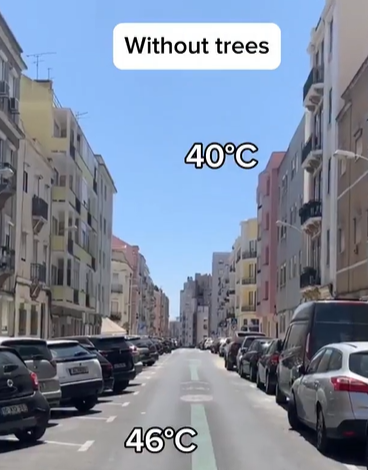
Research has shown that well-designed urban tree cover can reduce pedestrian-level temperatures by as much as 12°C under favorable conditions.
That difference is more than a matter of comfort.
It can reduce the risk of heat stress, heat exhaustion, and heat-related mortality particularly among older adults, children, outdoor workers, and people with underlying health conditions.
As climate change drives more frequent, intense, and prolonged heatwaves, trees are becoming an essential component of public health infrastructure.
More Than Shade: A Living Urban Infrastructure
Trees provide benefits that extend far beyond cooling.
Every mature tree functions as a piece of green infrastructure, continuously delivering ecosystem services that would otherwise require expensive engineered solutions.
They improve air quality by filtering fine particulate matter and absorbing pollutants such as nitrogen dioxide and ozone.
Their roots increase soil infiltration, reducing stormwater runoff and lowering the risk of urban flooding during heavy rainfall.
Their branches and foliage create habitat and food sources for birds, pollinators, insects, and countless other species, helping sustain biodiversity even within densely populated cities.
Strategically planted trees can also reduce building energy demand by shading walls and windows, lowering indoor temperatures and decreasing the need for mechanical cooling. This not only reduces electricity consumption but also lowers energy costs for households and businesses.
In this sense, every tree is simultaneously an air conditioner, an air filter, a stormwater management system, a biodiversity reserve, and a carbon sink.
Few pieces of urban infrastructure deliver so many benefits at such a low long-term cost.
Fighting the Urban Heat Island
Cities are often significantly warmer than surrounding rural areas because asphalt, concrete, steel, and glass absorb and retain heat throughout the day before slowly releasing it at night.
This phenomenon known as the urban heat island effect can increase local temperatures by several degrees, making heatwaves even more dangerous.
Urban forests help reverse this effect.
By replacing heat-absorbing surfaces with living vegetation, cities can moderate local temperatures, improve thermal comfort, and reduce the cumulative impacts of extreme heat.
In a warming world, planting trees is no longer simply an environmental initiative.
It is a climate adaptation strategy.
The Hidden Value of Mature Trees
Many cities proudly announce ambitious tree-planting campaigns.
While these initiatives are important, there is an often-overlooked reality:
A newly planted sapling cannot immediately replace a mature tree.
Large trees provide exponentially greater cooling, store far more carbon, support richer biodiversity, intercept substantially more rainfall, and deliver significantly more shade than young trees.
When decades-old trees are removed for roads, buildings, or infrastructure projects, the environmental services they provided disappear overnight—but may take generations to recover.
Protecting existing mature trees is often one of the fastest, most cost-effective climate actions a city can take.
The greenest city is not necessarily the one that plants the most trees.
It is the one that successfully protects the trees it already has.
Designing Cities Around Nature
For much of the twentieth century, urban planning prioritized automobiles, concrete, and expansion.
Today, cities face a different challenge.
How do we create neighborhoods that remain safe, comfortable, and livable in an increasingly unpredictable climate?
The answer lies not only in smarter buildings or advanced engineering but also in integrating nature into every aspect of urban design.
Tree-lined streets encourage walking and cycling by providing shade and thermal comfort.
Parks offer cooling refuges during heatwaves.
Green corridors connect fragmented habitats while improving air quality and stormwater management.
Mixed-use neighborhoods with abundant vegetation become healthier places to live, work, and socialize.
Urban forests are no longer decorative amenities.
They are critical infrastructure for climate resilience.
Investing in the Future We Want
Imagine a city where children can safely play outdoors during summer without scorching pavement beneath their feet.
Where older adults can comfortably walk to nearby shops without dangerous heat exposure.
Where local businesses benefit from vibrant, shaded public spaces that encourage people to linger rather than retreat indoors.
Where cleaner air, cooler temperatures, thriving biodiversity, and lower energy bills become everyday realities rather than ambitious sustainability goals.
This future does not depend on a single breakthrough technology.
It depends on thousands of thoughtful decisions made by planners, policymakers, developers, businesses, and communities to protect and expand urban forests.
Because climate resilience is not built only with concrete, steel, and technology.
It is also built with roots, branches, leaves, and healthy soils.
Nature Already Knows the Answer
As cities search for innovative solutions to climate change, it is worth remembering that some of the most effective technologies have existed for millions of years.
Trees ask for no electricity.
They generate no emissions.
They work every day.
And with every season, they quietly make our neighborhoods cooler, cleaner, healthier, and more resilient.
Perhaps the most important question is no longer:
“How many air conditioners will our cities need in the future?”
Instead, we should ask:
“How many trees can we protect and plant today?”
Because the most powerful air conditioner has never been a machine.
It has always been a tree.