Types of carbon explained
The Palette of a Warming World: Why Carbon Isn’t Just One Color
In the boardroom and the laboratory, carbon is often reduced to a single, ominous number on an emissions report. But treating carbon as a monolith is a strategic mistake. In reality, the climate crisis is painted in a full spectrum of colors from the soot-stained “Black” carbon in our lungs to the deep “Blue” carbon hidden in seagrass meadows.
Understanding this diverse “carbon palette” is no longer just for scientists; it is the new requirement for policymakers, businesses, and ESG professionals who want to move beyond simple math and into high-impact climate action.
The Spectrum of Climate Impact
Each “color” of carbon behaves differently, acting as either a catalyst for warming or a vital sink for stabilization.
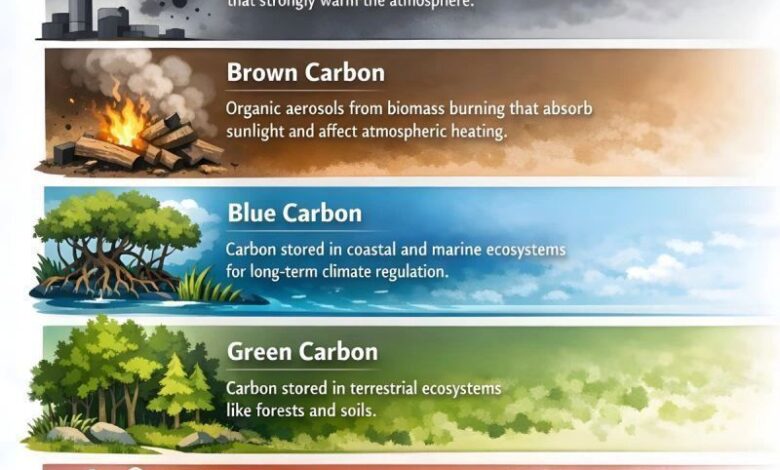
- Black Carbon (The Accelerator): Soot-like particles from diesel engines and industrial fires that absorb sunlight and heat the air directly.
- Brown Carbon (The Wildfire Legacy): Organic aerosols from biomass burning that create dangerous climate feedback loops.
- Blue Carbon (The Coastal Guardian): Mangroves and salt marshes that store carbon far more efficiently than forests on land.
- Green Carbon (The Earth’s Lungs): The terrestrial carbon stored in the very soil and vegetation that sustains our food systems.
- Red Carbon (The Ice Melter): Microscopic algae that darken glaciers, causing them to absorb heat and melt at alarming rates.
- Grey Carbon (The Industrial Engine): The massive volume of fossil-fuel emissions that remains the primary driver of long-term climate change.
Why the Nuance Matters for ESG and Strategy
Moving beyond “simple emissions counting” allows organizations to build more resilient strategies. By recognizing these distinctions, leaders can:
- Target Mitigation: Cutting Black and Brown carbon provides immediate air-quality and cooling benefits.
- Secure Resilience: Protecting Blue and Green carbon ecosystems ensures long-term climate stability and biodiversity.
- Improve Reporting: Aligning with nature-based solutions creates more credible ESG disclosures and risk assessments.
Carbon is not a uniform concept; it is a complex system of heroes and villains. To build a future-ready climate solution, we must learn to see the world in full color.
source: