Understanding scope 1, 2, and 3 emissions
The Hidden Crisis: Why Scope 3 is the Real Carbon Challenge and the Key to Net Zero
The transition to a Net Zero economy demands honesty about our environmental impact. For too long, companies have focused on their immediate doorstep, reporting modest reductions in Scope 1 and Scope 2 emissions the ‘easy wins.’ But this narrow focus obscures the profound truth: the vast majority of a company’s climate footprint lies hidden within its value chain.
True climate leadership is not about managing what’s convenient; it’s about owning the entire impact.
Unpacking the Emissions Hierarchy
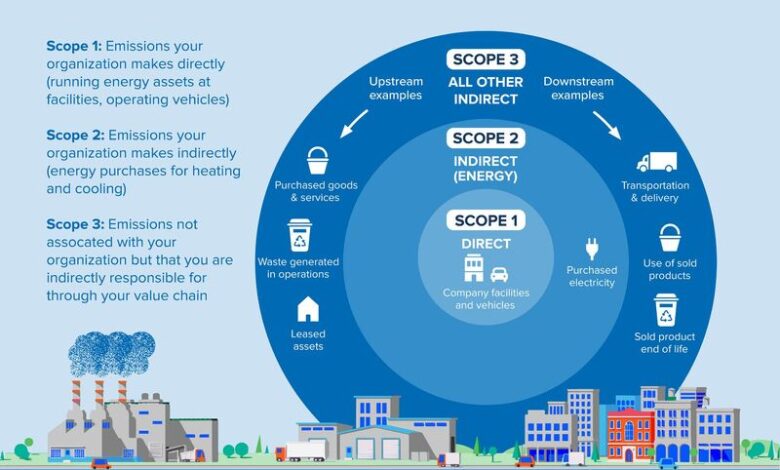
To understand the challenge, we must first recognize the three categories defined by the GHG Protocol:
- Scope 1: Direct Emissions (The Doorstep)These are GHGs released directly from assets the company owns or controls (e.g., fuel burned in company trucks, natural gas used in an on-site boiler). Easy to measure, easy to regulate.
- Scope 2: Purchased Energy Emissions (The Utility Bill)These are indirect emissions from the generation of purchased electricity, steam, heating, and cooling. Measurable and addressable through renewable energy procurement.
- Scope 3: Value Chain Emissions (The Iceberg)These are all other indirect emissions that occur up and down the company’s value chain, both upstream (suppliers) and downstream (product use, disposal). For most organizations especially in retail, tech, and consumer goods Scope 3 accounts for 70 % to 90 % of the total climate impact.
Scope 3: The Unavoidable Mountain
Focusing solely on Scope 1 and 2 creates a dangerous illusion of progress. While companies celebrate transitioning their headquarters to solar power (Scope 2), the bulk of their environmental damage from raw material extraction to the energy consumed when a customer uses their product is ignored.
This is the real issue:
- The Scale: Ignoring Scope 3 means ignoring the systemic challenge. No global climate goal is achievable if companies only account for 10 % to 30 % of their footprint.
- The Complexity: Scope 3 demands collaboration, transparency, and innovation across thousands of suppliers, logistics providers, and partners. It requires fundamental product redesign and influencing consumer behavior.
- The Risk: Regulators (e.g., the SEC and EU) are rapidly mandating the reporting of material Scope 3 emissions. Companies that lack the data and strategy now face significant compliance, financial, and reputational risk.
Strategy and Survival: Why Scope 3 is Mandatory
The future market leaders will be those who master the complexity of Scope 3.
- Resilience: Proactively working with suppliers to decarbonize creates a more stable, secure, and future-proof supply chain, insulating the business from future carbon prices or shortages.8
- Innovation: Tackling Scope 3 forces material and product innovation, leading to the creation of circular, lower-impact products that command a premium with informed consumers.9
- Accountability: Investors and customers are increasingly vetting companies based on genuine, full-spectrum accountability. Net Zero is an empty promise without a verified Scope 3 plan.
True climate leadership begins where the challenge is greatest: in the value chain.
source: