Tahukah Anda
Understanding the language of ESG Terminology every professional should know
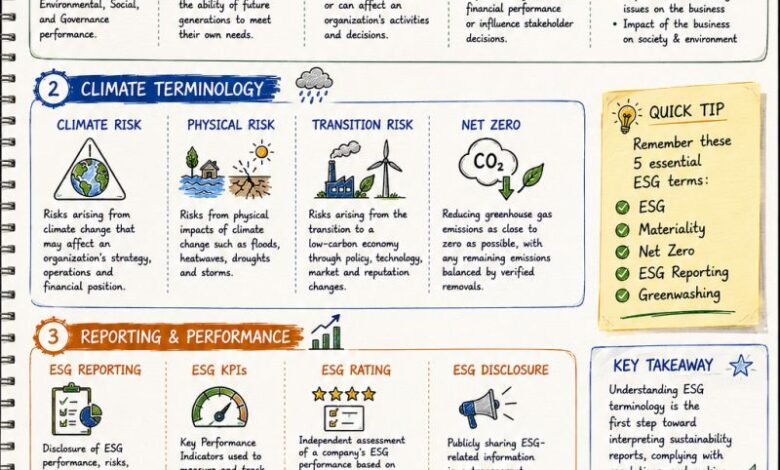
Navigating the landscape of Environmental, Social, and Governance (ESG) requires a clear understanding of its specialized vocabulary. As ESG transitions from voluntary disclosure to core financial reporting, mastering these key terms is essential for cross-functional alignment between sustainability, finance, risk management, and legal teams.
1. Fundamental ESG Concepts
- Materiality: The threshold at which an ESG topic becomes significant enough to influence business operations, financial performance, or stakeholder decision-making.
- Double Materiality: A two-way reporting lens required by frameworks like the EU CSRD:
- Financial Materiality (Outside-In): How environmental and social factors impact the company’s financial performance.
- Impact Materiality (Inside-Out): How the company’s operations impact society and the natural environment.
- Stakeholder Engagement: The process of consulting key groups (investors, employees, suppliers, customers, and communities) to identify material ESG priorities and risks.
- ESG Integration: The systematic incorporation of ESG risk metrics into core corporate strategies, financial forecasting, and enterprise risk management (ERM).
2. Decarbonization & Climate Terminology
[Scope 1: Direct Emissions]   ──> Owned / Controlled Assets (e.g., Factories, Fleet)
[Scope 2: Indirect Emissions] ──> Purchased Energy (e.g., Electricity, Steam, Heating)
[Scope 3: Value Chain]        ──> Upstream & Downstream Activities (e.g., Supply Chain, Product Use)
- Scope 1 Emissions: Direct greenhouse gas (GHG) emissions originating from sources owned or directly controlled by the organization.
- Scope 2 Emissions: Indirect GHG emissions resulting from the generation of purchased electricity, steam, heating, or cooling consumed by the organization.
- Scope 3 Emissions: All other indirect GHG emissions occurring across the company’s broader value chain (both upstream suppliers and downstream product use).
- Net-Zero: Reducing greenhouse gas emissions as close to zero as possible across Scopes 1, 2, and 3, with any remaining residual emissions permanently neutralized through verified carbon removals.
- Carbon Neutrality: Balancing emitted carbon with an equivalent amount of carbon offsets or credits, often focusing primarily on Scopes 1 and 2.
- Decarbonization: The systematic reduction of carbon intensity across corporate operations, supply chains, and energy sources.
3. Reporting, Frameworks & Governance Terms
- Assurance (Internal & External): The independent audit and verification of non-financial ESG data to ensure accuracy, reliability, and auditability.
- ISSB (International Sustainability Standards Board): The global standard-setting body under the IFRS Foundation that established baseline sustainability (IFRS S1) and climate (IFRS S2) disclosures.
- GRI (Global Reporting Initiative): The widely adopted global framework for reporting a company’s impact on economy, environment, and people (Impact Materiality).
- CSRD (Corporate Sustainability Reporting Directive): European Union legislation mandating comprehensive ESG disclosures for EU and non-EU companies operating within the EU market.
4. Risk, Misconduct & Strategy Terms
| Term | Definition & Strategic Context |
| Greenwashing | Making deceptive, exaggerated, or unsubstantiated claims about the environmental benefits of a product, service, or corporate practice. |
| Greenhushing | The practice of intentionally underreporting or hiding corporate sustainability goals to avoid public scrutiny, litigation, or accusations of greenwashing. |
| Stranded Assets | Assets that suffer premature write-downs, devaluations, or conversion to liabilities due to regulatory shifts, climate risks, or technological transitions. |
| Just Transition | Ensuring that the transition toward a low-carbon economy is equitable and fair, protecting workers, livelihoods, and local communities. |
| Supply Chain Due Diligence | The process of auditing suppliers for human rights violations, fair labor practices, and environmental compliance. |
20-Part ESG Fundamentals Series Roadmap
- Part 1: Introduction to ESG: Foundations & Value Creation
- Part 2: History & Evolution of ESG: Global Overview
- Part 2B: ESG in Pakistan: History & Current Implementation Status
- Part 3: ESG Terminology Every Professional Should Know (Current)
- Part 4: ESG Frameworks & Global Standards (GRI, ISSB, TCFD, CSRD) (Next Up)
- Part 5–20: Deep Dives into E, S, G Execution, Carbon Accounting, and Strategy Integration