Tahukah Anda
70+ Types of carbon credit projects
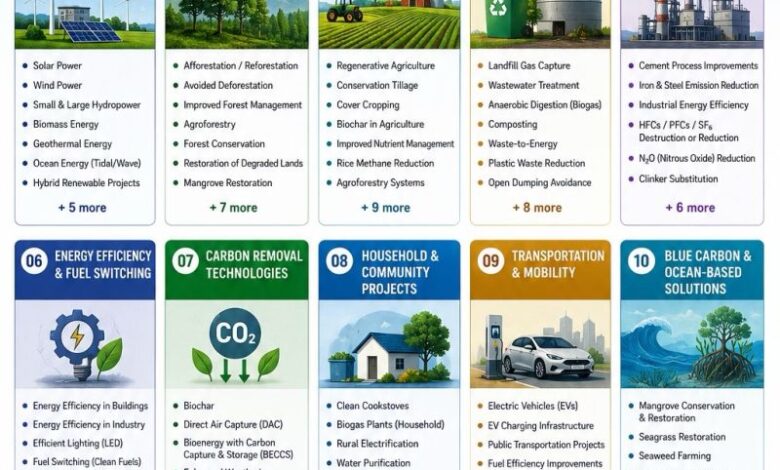
Spectrum of Carbon Project Types
Carbon projects fall into two core categories: Emissions Avoidance/Reduction (stopping gases from entering the atmosphere) and Carbon Removal/Sequestration (actively pulling existing CO2 out of the atmosphere).
| Category | Primary Project Types | Core Mechanism |
| Forestry & Nature | • Afforestation / Reforestation • Avoided Deforestation (REDD+) • Agroforestry & Forest Management | Sequesters carbon in living biomass, soil, and forest ecosystems. |
| Agriculture | • Regenerative Farming & Soil Carbon • Rice Methane Reduction (Alternate Wetting/Drying) • Fertilizer & Livestock Management | Reduces agricultural emissions (CH4, N2O) and builds soil organic carbon. |
| Technological Removal | • Biochar & BECCS • Direct Air Capture (DAC) • Enhanced Weathering & Mineralization | Permanently traps or mineralizes atmospheric carbon into stable forms. |
| Waste & Methane Capture | • Landfill Gas-to-Energy • Anaerobic Digestion & Composting • Advanced Wastewater Treatment | Captures high-GWP methane before release and converts it to useful energy. |
| Industrial & Efficiency | • Industrial F-Gas Destruction • Process Efficiency & Fuel Switching • Efficient Cooling Infrastructure | Eliminates high-impact industrial gases and lowers energy intensity. |
| Community & Household | • Clean Cookstoves & Biogas • Water Purification Systems • Rural Off-Grid Electrification | Replaces biomass burning with clean tech, yielding environmental and social co-benefits. |
The Anatomy of High-Integrity Carbon Credits
Developing a viable carbon credit project requires proving rigorous technical criteria. Without these foundational pillars, credits risk being discredited as greenwashing:
- Additionality: Proving the project would not have occurred without financial support from carbon credit revenues.
- Baseline Calculation: Establishing a scientifically sound, conservative benchmark of what emissions would have been under business-as-usual conditions.
- Robust MRV (Monitoring, Reporting, & Verification): Implementing continuous, data-driven tracking often leveraging remote sensing, IoT sensors, and third-party audits to measure real performance.
- Permanence & Leakage Prevention: Ensuring stored carbon remains locked away long-term (or backed by buffer pools) while verifying that emissions are not simply displaced elsewhere.
The Strategic Shift: From Trading Speculation to Project Development
The carbon economy is transitioning away from low-quality, middleman-driven trading toward direct project development and engineering. Market capital is increasingly gravitating toward high-integrity, high-permanence projects that deliver verifiable impact alongside measurable social and biodiversity co-benefits.