The land footprint of food
Your Plate, Your Planet: The Hidden Power of the Menu
What if the most effective climate technology wasn’t a carbon-capture machine or a massive wind farm, but your dinner plate?
It’s easy to think of “the environment” as something happening out there in the rainforests or at the melting poles. But the reality is that our food system is the primary architect of the global landscape. When we choose what to eat, we aren’t just nourishing ourselves; we are casting a vote for how Earth’s land is used, protected, or destroyed.
The Massive Footprint of Meat
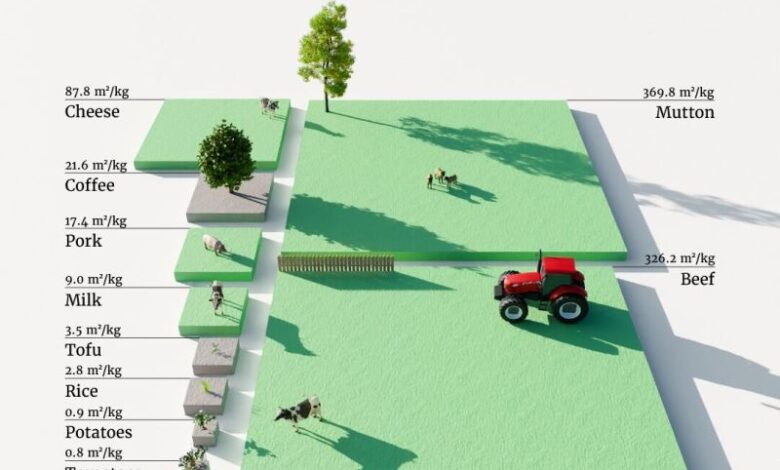
The disparity in land use between different foods is staggering. To visualize the impact, consider the “rent” each food pays in terms of Earth’s surface area:
| Food Type (1kg) | Land Use Required (Approx.) |
| Beef | 326 square meters |
| Lamb & Mutton | 370 square meters |
| Poultry | 12 square meters |
| Rice | 2.8 square meters |
| Apples | 0.6 square meters |
When we demand beef, we demand space. Hundreds of square meters are required for a single kilogram of meat space that was often once a thriving forest or a vital grassland.
Why Land is Our Best Defense
Every acre of forest cleared for grazing is a double-blow to our climate stability:
- The Loss of the “Lungs”: Forests are critical carbon sinks. When they are razed, we lose our natural ability to scrub CO2 from the atmosphere.
- The Methane Surge: Livestock don’t just take up space; they are active emitters. The methane produced by ruminants is a greenhouse gas significantly more potent than carbon dioxide in the short term.
By continuing our current trajectory of land-heavy diets, we are effectively trading our planet’s cooling systems for calorie sources that accelerate the heat.
The Plant-Based Advantage: Efficiency as Action
The beauty of plant-based foods lies in their efficiency. Because crops like grains, legumes, and vegetables can be grown with a fraction of the land and water, shifting toward them allows us to “rewild” the planet.
Imagine a world where the vast tracts of land currently used for feed-crops are returned to nature. This isn’t just about “saving trees” it’s about creating a resilient ecosystem capable of weathering the storms, droughts, and heatwaves of the future.
This isn’t an invitation to guilt, but an invitation to agency. You don’t need to be a perfect vegan to be a climate hero.
Reducing your red meat consumption by even 50% does more for your personal carbon footprint than almost any other lifestyle change.
Every meal is a tactical decision. Every grocery trip is a chance to protect a forest. By rethinking what we put on our plates, we stop being passive observers of climate change and start becoming active participants in the planet’s recovery.
source: