The ABCs of Green Building
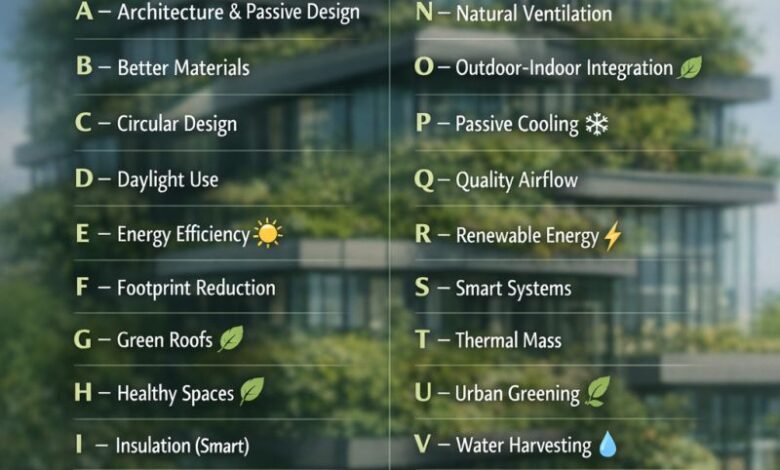
The Green Building Manifesto: From Structures to Ecosystems
The buildings of the future are no longer passive shells; they are active participants in the environment. By shifting from extractive design (taking energy and water) to regenerative design (contributing to the grid and ecology), we are rewriting the blueprint of urban life.
1. The Core Pillars of Performance
A green building is defined by three critical intersections: Efficiency, Experience, and Ecology.
- Passive Survivability: Designing for “thermal resilience.” Through high-performance insulation and strategic orientation, buildings maintain livable temperatures even during power outages or extreme heatwaves.
- Biophilic Integration: More than just aesthetics, integrating natural light and vegetation reduces cortisol levels and boosts cognitive performance by up to 26% in office environments.
- The Circular Skeleton: Using “Materials Passports” low-carbon, non-toxic, and reclaimed materials ensures that a building’s end-of-life is a new beginning, not a landfill entry.
2. The Technological Architecture
Modern green building utilizes a “Digital Nervous System” to optimize resource consumption in real-time.
| Strategy | Mechanism | Impact |
| Smart Envelopes | Dynamic glazing that tints based on sun intensity. | Reduces cooling loads by up to 20%. |
| Net-Positive Water | Rainwater harvesting + Greywater recycling for irrigation. | Cuts municipal water demand by 40-60%. |
| Energy Decoupling | On-site renewables (PV/Wind) + Battery storage. | Transforms buildings into “Micro-grids.” |
3. The Lifecycle Perspective: Embodied vs. Operational Carbon
To be truly “Green,” we must account for the carbon footprint of the entire timeline.
- Operational Carbon: The energy used to heat, cool, and light the building. This is tackled through LEDs, HVAC efficiency, and smart sensors.
- Embodied Carbon: The hidden emissions from manufacturing steel, cement, and glass. The new frontier involves using Mass Timber or Carbon-Cured Concrete to “lock” carbon into the structure itself.
4. The Economic Logic: Low Impact, High Value
The “Green Premium” is rapidly disappearing. While initial costs might be slightly higher, the long-term ROI is undeniable:
- Lower OpEx: Drastic reductions in utility bills.
- Asset Appreciation: Certified buildings (LEED, BREEAM, EDGE) command higher resale values and lower vacancy rates.
- Health Dividends: Reduced respiratory issues and increased productivity for occupants.
The Path Forward: Retrofitting the Legacy
The greatest challenge isn’t the buildings we haven’t built yet it’s the ones that already exist. Deep Energy Retrofits are the “secret weapon” of climate action. By upgrading insulation, windows, and systems in existing structures, we can slash urban emissions without the carbon cost of new construction.