
California wildfires aftermath: navigating preparedness in the burning climate
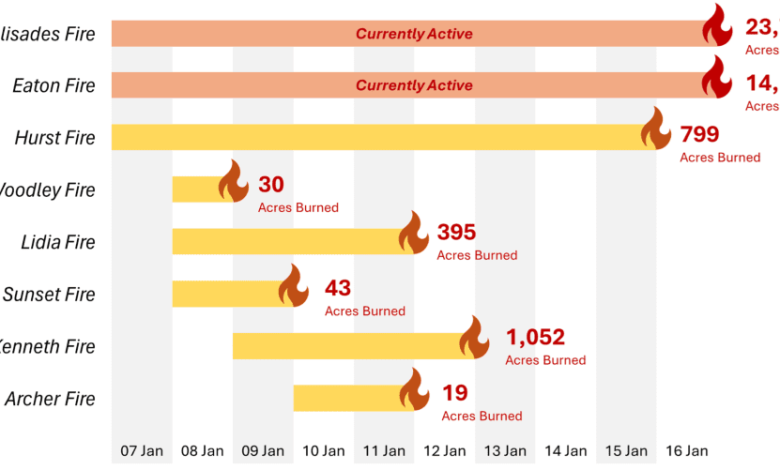
In early January 2025, Southern California faced one of the most devastating wildfire events in recent history, fueled by a dangerous combination of prolonged drought, unusually dry vegetation, and relentless Santa Ana winds. This unprecedented crisis has scorched over 40,000 acres, claimed 25 lives, destroyed 12,000 structures, and caused an estimated economic loss of $250 billion. It has sent a stark message: climate change is not a distant threat but a current and compounding reality.
A Tragic Beginning: The Palisades and Eaton Fires
The wildfires erupted on January 7, starting with the Palisades Fire and the Eaton Fire in Los Angeles. These fires quickly escalated, driven by the powerful Santa Ana winds that typically sweep through Southern California between late September and May. By January 17, the fires had engulfed over 40,696 acres, an area equivalent to 24.8% of Jakarta or 6.1 times the size of Sydney. Tragically, the Palisades and Eaton Fires were responsible for 93% of the burned area, 89% of the destroyed structures, and all reported fatalities.
For a region accustomed to wildfires during the summer and fall, the severity of this winter wildfire season was startling. Historically, wildfires in January burned an average of just 5,000 acres annually between 2013 and 2024. In contrast, January 2025 witnessed a staggering eightfold increase, driven by months of above-average temperatures and critically low precipitation.
Climate Change: A Catalyst for Disaster
The root of this alarming surge lies in climate change, which has intensified wildfire risks by amplifying the core drivers of fire activity—heat, dryness, and wind. From October to December 2024, the wildfire-affected areas experienced a 1°C increase in temperature and a precipitation decline of up to 100%. These conditions dried out vegetation and created a tinderbox effect, primed for ignition and rapid spread.
Climate models predict that such scenarios will become increasingly common. Global land areas affected by wildfires are projected to expand by 35% under 2°C warming and by 40% under 4°C warming. Furthermore, fire seasons in the U.S. are expected to grow longer, compounding risks for regions like Southern California, where weather, topography, and vegetation already create a perfect storm for wildfires.
Beyond the Flames: Cascading Threats
The impact of the Los Angeles wildfires extends far beyond the immediate destruction. Ecologically, vast swaths of scorched land—home to diverse wildlife—face long-term disruption. The loss of vegetation has left slopes vulnerable to soil erosion, increasing the likelihood of landslides in the aftermath of heavy rains. Moreover, air quality across the Greater Los Angeles Area has plummeted, exposing millions to hazardous levels of particulate matter, which can cause respiratory and cardiovascular illnesses.
Adapting to the ‘New Normal’: Key Lessons and Strategies
The January 2025 wildfires underscore the urgent need for a multifaceted approach to wildfire management, combining prevention, mitigation, and recovery strategies.
1. Vegetation Management and Prescribed Burns
Reducing wildfire fuel, such as dry shrubs and fallen logs, is critical. California’s Wildfire and Forest Resilience Action Plan emphasizes prescribed burns—controlled fires that reduce excess vegetation. This method, successfully implemented in countries like Indonesia and Australia, could help prevent future megafires.
2. Innovative Climate Solutions
Emerging technologies, such as cloud seeding to enhance precipitation, offer additional tools. While these methods require further research to assess their impact on fire hotspots, they could complement traditional mitigation efforts.
3. Post-Fire Rehabilitation and Resilience
Recovery efforts must prioritize ecological restoration and community resilience. Soil stabilization, vegetation replanting, and the use of climate-resilient seedlings can restore ecosystems while preparing them for future challenges. However, these efforts must be paired with robust fire prevention measures to ensure sustainability.
4. Fire-Resilient Infrastructure
Building construction plays a pivotal role in wildfire resilience. Los Angeles has implemented regulations mandating fire-resistant roofs and siding for new homes, but a significant portion of housing predates these rules. Accelerating retrofitting programs and revising zoning laws to discourage development in high-risk wildfire zones are essential steps.
5. Early Warning and Community Preparedness
Despite advancements like ALERTCalifornia, an AI-powered fire detection system, the January wildfires revealed gaps in response capabilities. Investments in early warning systems must prioritize not only technology but also community engagement, ensuring that residents are equipped to act swiftly in emergencies.
A Call to Action: Building Back Better
The devastation caused by the January 2025 wildfires presents a stark but necessary opportunity to rethink how we coexist with a changing climate. Building back better means prioritizing fire-resilient materials, accelerating retrofitting efforts, and promoting housing development in safer areas. It also means fostering a culture of preparedness, where individuals, communities, and governments work together to mitigate risks and respond effectively to disasters.
As climate change continues to intensify extreme events, anticipatory action is no longer optional—it is a necessity. The Los Angeles wildfires serve as a wake-up call, reminding us of the urgency to adapt, innovate, and collaborate in the face of an uncertain future. While the road ahead is challenging, it is also an opportunity to build a safer, more resilient world for generations to come.


