Regulatory Landscape Against Greenwashing
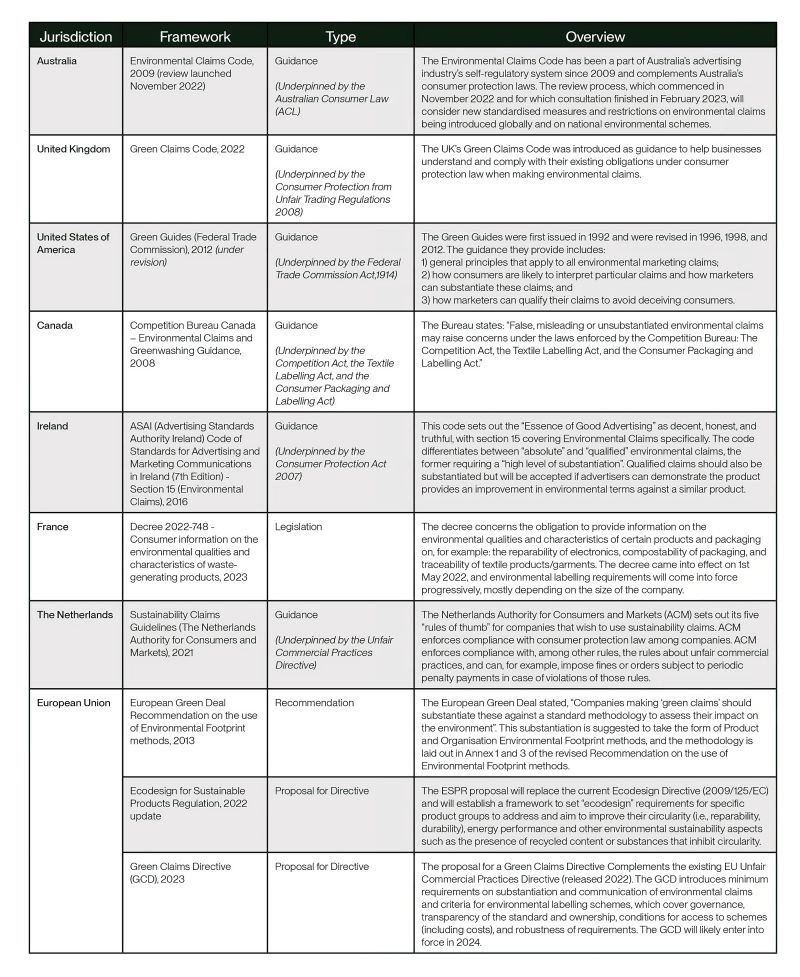
Regulations to prevent greenwashing are becoming increasingly stringent as governments and regulatory bodies worldwide seek to ensure that environmental claims are accurate, transparent, and verifiable.
Historically, misleading green claims were regulated under general consumer protection laws, but the growing prevalence of sustainability-related marketing has led to more specific guidelines. Authorities such as the UK’s Competition and Markets Authority (CMA) and the European Commission have introduced new frameworks, including the Green Claims Code and the Green Claims Directive (GCD), to provide stricter oversight and enforcement. These initiatives aim to prevent businesses from using vague or deceptive sustainability claims to mislead consumers.
Regulatory enforcement has intensified, with an increasing number of lawsuits and penalties for companies found guilty of greenwashing. In recent years, consumer protection agencies and advertising regulators in the US, UK, and EU have taken legal action against major brands that have misrepresented their environmental impact. Beyond government interventions, watchdog organizations and class-action lawsuits are holding companies accountable, resulting in substantial financial and reputational consequences.
One of the key areas of regulatory focus is third-party certifications, which many companies use to validate their environmental credentials. However, the credibility of certification schemes varies widely, and some have been criticized for lacking independent verification or rigorous standards. To address this, the GCD explicitly bans self-certified sustainability labels and mandates that all new certifications undergo prior approval before being used in the EU. Only those that demonstrate meaningful environmental impact and transparency will be permitted, reducing the risk of misleading claims disguised under weak or unregulated certifications.
Another significant shift in greenwashing regulations is the requirement for companies to consider the entire lifecycle of their products when making sustainability claims.
As regulations become more stringent, companies will need to proactively adapt their sustainability strategies to remain compliant and credible. The shift towards greater transparency, stricter verification processes, and lifecycle-based assessments signals a new era of accountability in corporate sustainability.
Businesses that fail to meet these evolving standards risk legal action, financial penalties, and consumer distrust, while those that embrace more rigorous sustainability reporting and certification processes will be better positioned to build trust and demonstrate genuine commitment to environmental responsibility.
Source: Anthesis Group