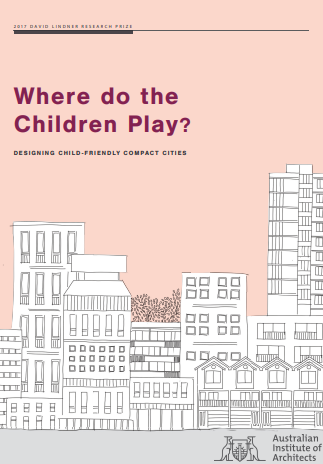
Where do the children play?
Australian cities are densifying at a rapid rate. This is particularly evident in Sydney, where it is predicted
that the population will double in size in just over 40 years and by 2031 almost half of Sydney’s housing
stock will be in the form of high density. With the urban landscape of cities shifting to higher densities,
it is inevitable that an increasing number of families with children are choosing to live in apartments and medium density housing. We are already seeing 28% of apartments in Sydney occupied by households with children and this number is growing throughout almost all Australian state capitals. As our cities continue to densify and open space becomes increasingly valuable, it is important to ask the question ‘where do the children play?’ to ensure the wellbeing of our youngest citizens is nurtured in the planning of cities. Apart from the changing landscape of our cities, the complexity of the question posed also comes from a broad shift in the way that children interact with their environments. As summarized by a study titled “Children in the City: Reclaiming the Street”.
With a growing body of research linking the bene! it’s of play and active mobility in children’s lives to positive health and wellbeing outcomes, it is paramount for communities and city designers to consider the strategies known to promote these outcomes. This report focuses on a series of physical interventions which can be implemented in the urban city context to promote play and independent active mobility
of children. Acknowledging that no physical outcome can be truly successful without social change, a series of supporting social and policy based recommendations have been put forward for parallel
consideration. The title of the report ‘Where do the Children Play?’ is intended as an open question, often ignored or simpli! ed by designers, planners and councils, resulting in communities which could be labeled as ‘child-blind’ (Woolcock & Gleeson 2010). The report takes the stance, that this question should form a founding part of the design of new developments and the revitalisation of existing ones. The report delves further into this question challenging the ways in which children access spaces independently and how they can be acknowledged as citizens in their own right within city design. Sydney, being Australia’s most densi! ed city, is in urgent need of a comprehensive strategy for meeting children’s needs in the compact city. This report highlights some of the key issues and proposes a set of interventions for implementation.
source :