Actions to Reduce Scope 3 Emissions
Scope 3 emissions typically account for the largest share of a company’s carbon footprint, covering indirect emissions across the entire value chain. Addressing them effectively requires a multifaceted approach that engages suppliers, customers, and other stakeholders.
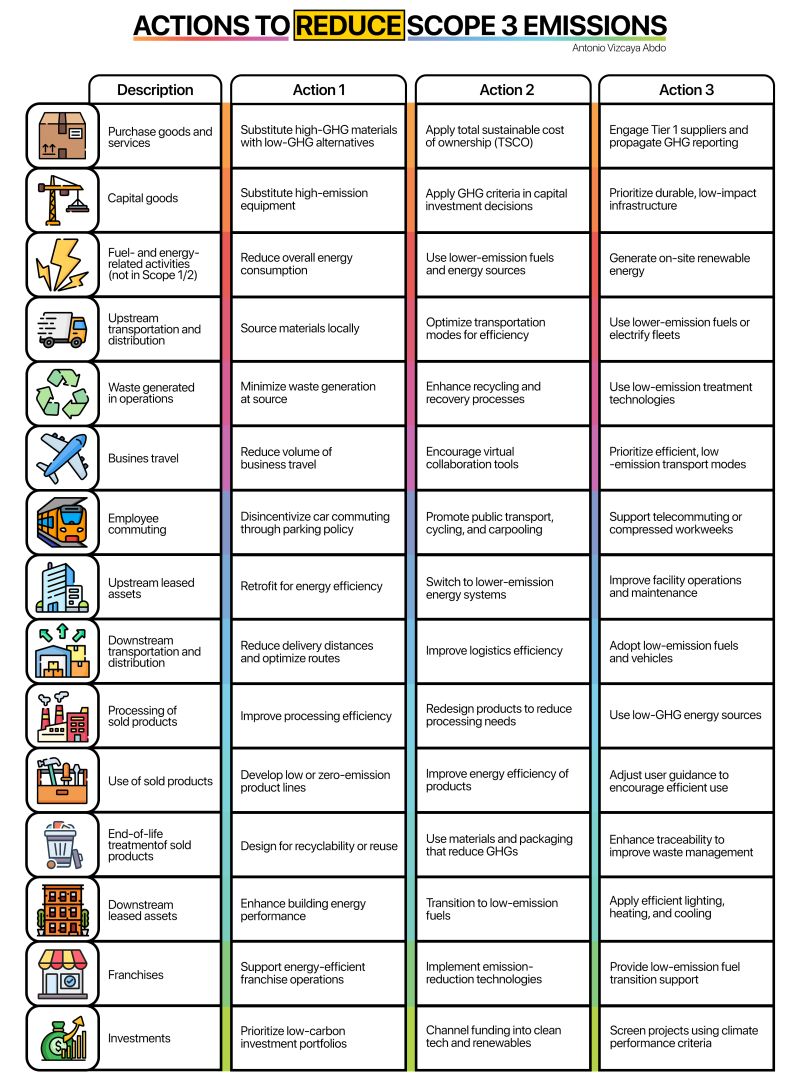
This framework outlines clear actions across key Scope 3 categories, ranging from procurement to investments. Each action is categorized into three progressive levels, encouraging companies to start with quick wins and advance toward deeper integration and systemic change.
In purchasing and capital goods, strategies include substituting high-GHG materials and equipment, applying GHG criteria in investment decisions, and engaging suppliers to standardize emissions reporting. These measures aim to embed sustainability criteria across the sourcing process.
For energy-related activities and transportation, reducing energy consumption, switching to lower-emission fuels, and electrifying fleets play a critical role. While some listed actions—such as on-site renewable generation—typically fall under Scope 1 or 2, they remain integral to broader decarbonization strategies.
Operational waste and product lifecycle emissions require both upstream and downstream interventions. Companies can minimize waste at source, enhance recycling processes, and design for recyclability, ensuring materials remain in circulation and emissions are mitigated across product life cycles.
Business travel, employee commuting, and leased assets offer opportunities to reduce emissions through virtual collaboration tools, promotion of public transport, retrofitting for energy efficiency, and improving facility operations—highlighting the value of internal policies and infrastructure upgrades.
Downstream logistics and product use demand focused improvements in logistics efficiency and product energy performance. Encouraging efficient product use and adopting low-GHG energy sources can reduce the footprint associated with sold goods and services.
Franchise and investment-related emissions emphasize the importance of supporting energy-efficient operations and prioritizing low-carbon investment portfolios. Channeling funding into clean tech and applying rigorous climate criteria to investment decisions are essential for long-term impact.
The success of Scope 3 reduction strategies depends not only on technical interventions but also on clear governance and collaboration frameworks. Accurate data collection, traceability, and continuous engagement across the value chain ensure sustained progress.
Comprehensive Scope 3 management is vital for achieving credible net-zero targets. This framework provides a roadmap to operationalize reductions, integrating climate action into the heart of corporate strategy and ensuring alignment with global decarbonization goals.
Source: