Climate change system map
Navigating the Climate Labyrinth: A Systems Approach to Understanding Our Warming World
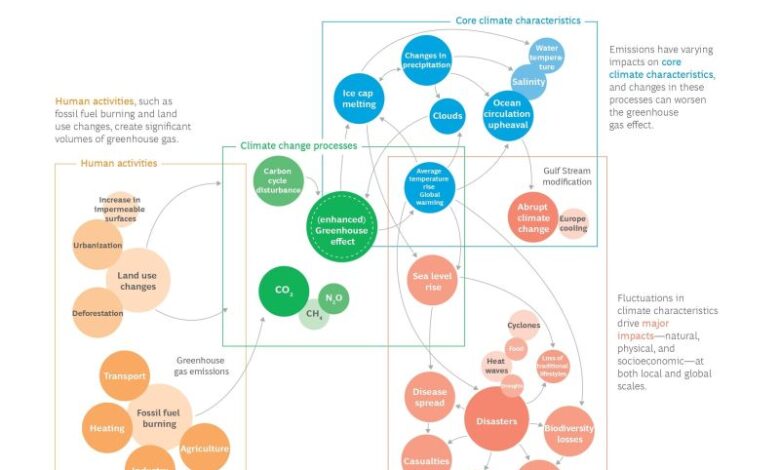
Climate change is far more than a simple equation of emissions in and temperature up. It’s a vast, intricate web, a dynamic system where every human action sends ripples through environmental processes, creating far-reaching consequences that touch every corner of our planet and societies. To truly grasp its magnitude, we must embrace a systems thinking approach, unraveling the complex threads of cause and effect that bind us to this global challenge.
At its core, climate change is fueled by human-driven activities. Picture the exhaust from our cars, the smoke from industrial factories, the clear-cut forests, and the vast agricultural fields. These actions relentlessly pump greenhouse gases carbon dioxide, methane, nitrous oxide into our atmosphere. As these invisible gases accumulate, they act like an ever-thickening blanket, intensifying the greenhouse effect and throwing Earth’s delicate climate system into disarray.
These disruptions don’t just manifest as warmer days. They trigger a cascade of interconnected changes: rising temperatures, shifting precipitation patterns, alterations in ocean salinity, changes in cloud formation, and imbalances in the crucial carbon cycle. Each of these elements interacts, creating feedback loops that amplify risks and deepen uncertainties. It’s like a complex machine where one gear spinning faster makes another accelerate unpredictably.
Our ocean systems are central to this intricate dance. Even slight variations in water temperature and salinity can destabilize mighty ocean currents, potentially altering large scale patterns like the Gulf Stream. Imagine the ripple effect: a shift in these currents can trigger abrupt changes in regional climates, sending environmental shockwaves that extend far beyond the water’s edge, permeating into societal structures and daily lives.
As these climate parameters continue their relentless shift, they unleash compounding impacts across both ecological and human systems. We see it in rising sea levels encroaching on coastlines, the increasing ferocity of extreme weather events, the degradation of vital habitats, and the tragic loss of biodiversity. These aren’t just threats to the natural world; they directly undermine the very infrastructure and services our societies depend on.
The social consequences are equally profound and escalating. Climate change fuels food insecurity, forces displacement as communities become uninhabitable, introduces new public health threats, and destabilizes economies. It’s a cruel irony that the most vulnerable populations, especially in developing regions with limited capacity to absorb these shocks, bear the heaviest burdens.
These cascading effects powerfully underscore the urgent need for strategies rooted in systems thinking. Simply curbing emissions, while crucial, is insufficient if we overlook the intricate, interlinked risks and feedback loops. Effective climate action demands a holistic perspective recognizing how changes in one sector inevitably influence outcomes in others. This interconnectedness means that our adaptation and mitigation efforts must be meticulously coordinated, working in harmony rather than in isolation.
Ultimately, climate change is not a singular environmental issue; it is a systems challenge with far-reaching implications for energy, agriculture, infrastructure, health, migration, and finance. The solutions we seek must reflect this profound complexity, drawing from cross-disciplinary knowledge and embracing long-term planning that seamlessly aligns environmental integrity with the stability and well-being of societies worldwide.
source: