What is net zero?
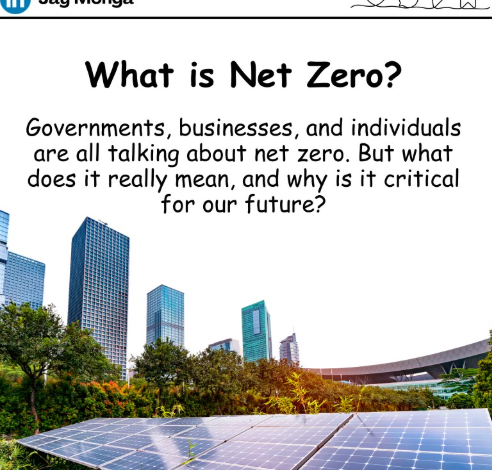
To understand Net Zero, we have to view the Earth like a bathtub. For decades, the “faucet” of carbon emissions has been wide open, and the “drain” (natural forests and oceans) hasn’t been able to keep up. Net Zero is the moment we balance the flow so the tub no longer overflows.
Here is a strategic breakdown of why Net Zero is the defining goal of the 21st century.
1. Defining the Balance: Emissions vs. Removal
Net Zero is reached when the amount of greenhouse gas (GHG) we add to the atmosphere is no more than the amount we take away. It is a two-part strategy:
- Deep Decarbonization: Reducing man-made emissions (Scope 1, 2, and 3) as close to zero as possible.
- Carbon Neutralization: Using technology or nature to “mop up” any remaining, unavoidable emissions.
2. The 1.5°C Threshold: The Science of Urgency
Why 1.5°C? Climate scientists warn that crossing this temperature threshold—relative to pre-industrial levels will trigger “tipping points.”
- The Risk: Mass coral bleaching, irreversible ice sheet melting, and extreme weather patterns that disrupt global food security.
- The Current Status: With global temperatures having hit 1.75°C in early 2025, the mission has shifted from “prevention” to “aggressive mitigation and adaptation.”
3. The Roadmap: How We Get There
Achieving Net Zero requires a total overhaul of our global industrial system through three primary levers:
A. Energy Transformation
Transitioning the power grid to wind, solar, and nuclear, while electrifying transport and heating. This eliminates the bulk of fossil fuel reliance.
B. Nature-Based Solutions
Protecting and restoring peatlands, mangroves, and forests. These are the world’s most efficient, low-cost carbon capture systems.
C. Technical Carbon Removal (CDR)
For industries that are “hard to abate” (like aviation or steel), we must scale technologies like Direct Air Capture (DAC) and Carbon Capture and Storage (CCS).
4. The Business Imperative: From Risk to Opportunity
For modern organizations, Net Zero is no longer a “nice-to-have” CSR goal; it is a fiduciary duty.
- Policy & Regulation: Governments are increasingly mandating carbon reporting and implementing carbon taxes.
- Access to Capital: Investors are shifting funds away from high-carbon assets toward “Green Finance.”
- Efficiency: Moving to Net Zero often reveals massive operational efficiencies, reducing waste and long-term energy costs.
5. The Critical Challenges
The path to Net Zero is not without friction. We are currently navigating:
- The Funding Gap: Trillions of dollars in investment are needed to transition developing economies.
- Policy Lag: Technology often moves faster than the laws required to support infrastructure (like national smart grids).
- Greenwashing: Ensuring that “Net Zero” claims are backed by science-based targets rather than just purchasing low-quality carbon offsets.
Final Thought: Net Zero isn’t just about stopping a disaster; it’s about redesigning an economy that is cleaner, quieter, and more resilient.
source: