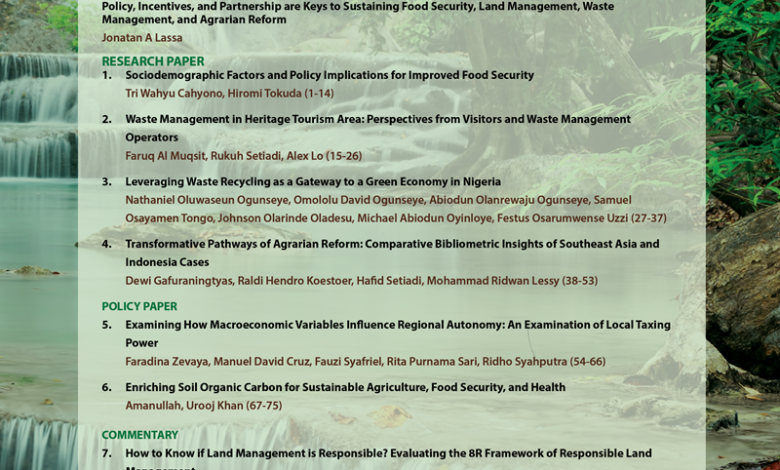
Policy, incentives, and partnership are keys to sustaining food security, land management, waste management, and agrarian reform
The Triple-Key Strategy: Unlocking Global Resilience
The April 2024 Issue presents a compelling argument: the survival of our modern world from the bustling streets of Nigeria to the shifting capitals of Indonesia depends on three master keys: Policy, Incentives, and Partnership. Without these, our goals for food security and land reform are merely aspirations.
1. The Jakarta-Nusantara Pivot: A Food Security Warning
Indonesia’s decision to move its capital to East Kalimantan is a bold leap into the future, but it comes with a shadow. Cahyono and Tokuda reveal that building a city isn’t just about steel and concrete; it’s about the sociodemographic pulse of the land.
- The Risk: Rapid population influx can suffocate local food systems.
- The Insight: Sociodemographic factors are the best predictors of whether a community will feast or famine during massive urban transitions.
2. Waste as Wealth: From Semarang to Nigeria
Waste management is no longer a “cleanup” task; it is a Green Economy engine. This issue bridges two very different worlds to prove the same point:
- The Tourism Lens (Indonesia): Al Muqsit et al. examine how the eyes of visitors in Semarang’s heritage areas can shape waste policy.
- The Household Lens (Nigeria): Ogunseye et al. demonstrate that when households are given the right incentives and partnerships, recycling becomes a pathway to equity and economic survival.
3. The Agrarian Puzzle: A Southeast Asian Comparison
Using the rigorous PRISMA framework, Gafuraningtyas et al. map the complex landscape of land reform across Southeast Asia.
- The Comparison: By weighing the successes of Vietnam and Thailand against the struggles in the Philippines and Timor Leste, the study identifies the “Goldilocks Zone” of agrarian policy—where government control meets local opportunity.
4. Macro-Foundations: Soil, Cash, and Responsibility
True sustainability requires looking at the ground beneath our feet and the ledgers in our banks. This issue rounds out its global survey with three critical perspectives:
- Fiscal Power (Jambi, Indonesia): How macroeconomic shifts dictate whether a local government has the “fiscal teeth” to implement decentralization.
- Biological Wealth (Pakistan): Amanullah and Khan argue that Soil Organic Carbon is the invisible thread connecting agriculture, food security, and public health.
- The Responsibility Test: De Vries introduces the 8R Framework, a diagnostic tool to determine if land management is truly “responsible” or just efficient.
The Global Policy Matrix
How the keys unlock the goals across the 2024 studies:
| Key | Function | Case Example |
| Policy | Establishing the “Rules of the Game” | Agrarian Reform (Southeast Asia) |
| Incentives | Driving Human Behavior | Waste Recycling (Nigeria) |
| Partnership | Scaling the Impact | Heritage Waste Management (Indonesia) |
source:
https://journal.pusbindiklatren.bappenas.go.id/lib/jisdep/article/view/552