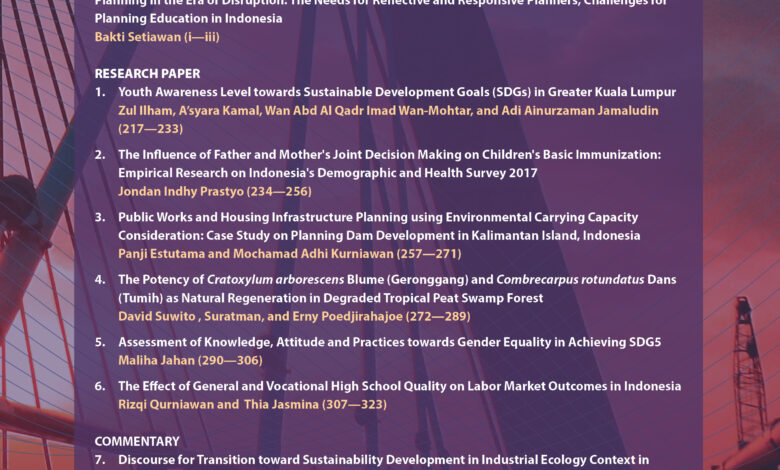
Discourse for transition toward sustainability development in industrial ecology context in Kutai Kartanegara
Transitioning Toward Sustainable Industrial Ecology in Kutai Kartanegara
1. The Primal Metabolism: A Natural Closed-Loop System
Kutai Kartanegara, a jewel of the East Kalimantan landscape, once stood as a masterclass in ecological efficiency. Historically, its vast evergreen forests functioned as a naturally occurring closed-loop system.
- Ecological Integrity: This “island metabolism” was characterized by high-efficiency nutrient cycling and carbon sequestration.
- Biodiversity as Capital: The system’s natural metabolism generated a wealth of both renewable and non-renewable resources, maintaining a delicate equilibrium that supported the region’s evolutionary resilience.
2. The Economic Paradox: From Ecosystem to Extraction
In recent decades, the region’s ecological value has been translated into intense economic output. However, this has shifted the system from a balanced biological metabolism to a linear industrial metabolism.
- The Coal Dependency: The energy sector has become the dominant driver of the regional economy. In 2010, coal alone accounted for over 80% of Kutai Kartanegara’s Gross Regional Domestic Product (GRDP).
- The Resource Curse: While this extraction provided massive short-term economic gains for both the region and the nation, it created a structural dependency on a finite, non-renewable resource, disrupting the ancient closed-loop system of the evergreen forest.
3. The Discourse for Transition: Re-imagining Industrial Ecology
The path toward Sustainable Development in Kutai Kartanegara requires a fundamental reimagining of how industry interacts with the tropical peat and forest ecosystems. The transition involves three critical pillars:
| Pillar | Transition Strategy |
| Decoupling | Reducing the region’s economic reliance on coal extraction to prevent total fiscal collapse as global energy markets shift. |
| Industrial Symbiosis | Implementing frameworks where the “waste” of one industrial process becomes the “input” for another, mimicking the forest’s original metabolism. |
| Regenerative Economy | Shifting investment toward the “renewable” side of the region’s ecological value focusing on bio-economy and ecosystem services. |
4. Conclusion: Restoring the Loop
Kutai Kartanegara stands at a crossroads. The challenge is no longer just “managing” resources, but re-integrating industrial activity into the biological reality of the land. By applying the principles of industrial ecology, the region can move away from the fragility of a coal-centric economy and back toward the resilience of a closed-loop system one that honors its tropical heritage while securing its economic future.
The transition is not merely about environmental protection; it is about an “ecological upgrade” of the regional economy to ensure long-term survival in a post-extraction world.
source:
https://journal.pusbindiklatren.bappenas.go.id/lib/jisdep/article/view/191