Food Waste: Hidden Resource Revolution
Food Waste: Hidden Resource Revolution
Food waste is often seen as the end of the line — something to discard. But in reality, it is one of the most undervalued resources in the circular economy.
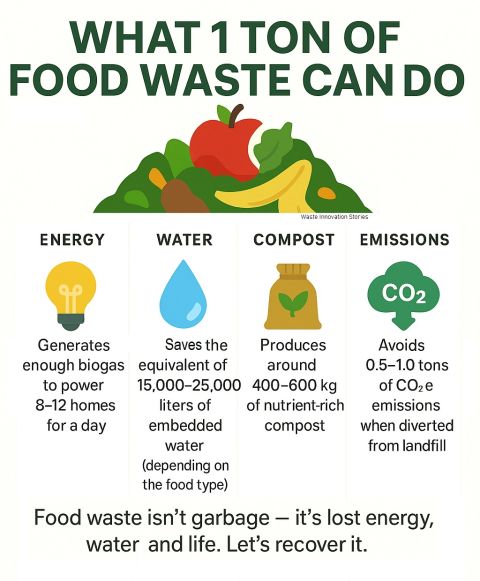
When managed through waste innovation systems, just 1 ton of food waste can be transformed into real environmental value:
⚡ Energy Recovery
Food waste can be converted into biogas, producing enough energy to power 8–12 homes for a day.
💧 Water Savings
It contains a large amount of embedded water — recovering it can save around 15,000–25,000 liters of water resources.
🌿 Soil Regeneration
Through composting, 1 ton of food waste can generate 400–600 kg of nutrient-rich organic fertilizer, reducing dependence on chemical inputs.
🌍 Carbon Reduction
Instead of releasing methane in landfills, proper treatment can prevent 0.5–1 ton of CO₂e emissions from entering the atmosphere.
Why this matters:
Food waste is not just a disposal challenge — it is a resource recovery opportunity.
When scaled across cities, it enables:
⚡ Local renewable energy production
🌱 Regenerative agriculture systems
♻️ Reduced landfill pressure
🌍 Measurable progress toward net zero goals
🔥 The bigger shift
The future of waste management is not about “throwing away less” — it is about recovering more value from what we already use.
Food waste becomes:
➡ Energy
➡ Fertilizer
➡ Climate savings
➡ Circular economy input
In a true circular system, waste is not the end — it is the beginning of something new.