
7 Type of carbon offset projects
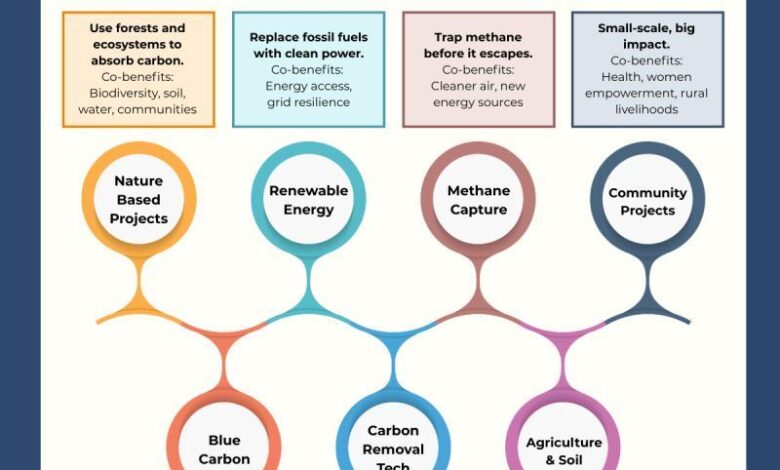
Evaluating the 7 Core Project Types and Their Integrity
The phrase “carbon offset” covers a wide variety of environmental initiatives, each with very different mechanics, costs, and long-term durability. As corporate net-zero targets face increasing scrutiny, understanding the differences between these projects is essential.
Carbon offsets are generally divided into two main categories: Avoidance/Reduction (preventing new emissions from entering the atmosphere) and Removal/Sequestration (actively pulling existing $CO_2$ out of the air).
The 7 Primary Types of Carbon Offset Projects
1. Afforestation and Reforestation (Nature-Based Removal)
This method involves planting new forests on lands that have not been forested recently (afforestation) or restoring degraded forest ecosystems (reforestation).
- How it works: Trees naturally absorb $CO_2$ through photosynthesis and store it as biomass in their trunks, branches, and soil.
- Co-Benefits: Restores local biodiversity, prevents soil erosion, and regulates regional water cycles.
- Risks: Reversibility. If a forest burns down in a wildfire or is legally logged later, the stored carbon is immediately released back into the atmosphere.
2. Avoided Deforestation / REDD+ (Nature-Based Avoidance)
REDD+ (Reducing Emissions from Deforestation and Forest Degradation) funds the protection of existing, threatened forests.
- How it works: It prevents carbon loss by financially incentivizing local communities and governments to protect forests instead of clearing them for agriculture or logging.
- Co-Benefits: Preserves intact habitats for endangered species and supports indigenous land rights.
- Risks: Leakage. Protecting one specific patch of forest might simply cause logging companies to move their operations a few miles away, resulting in zero net carbon savings.
3. Blue Carbon Initiatives (Marine-Based Removal & Avoidance)
This approach focuses on protecting and restoring coastal and marine ecosystems, specifically mangroves, salt marshes, and seagrass meadows.
- How it works: Marine vegetation captures carbon up to 10 times faster per acre than terrestrial tropical rainforests, locking it deep into underwater sediment for centuries.
- Co-Benefits: Provides critical storm-surge buffering for coastal cities and protects marine nurseries.
- Risks: Highly vulnerable to rising sea temperatures, coastal development, and marine pollution.
4. Biochar and Soil Carbon Sequestration (Agricultural Removal)
This process changes how agricultural lands are managed to turn farming soils into active carbon sinks.
- How it works: Biochar is created by heating agricultural waste in the absence of oxygen (pyrolysis), producing a stable, carbon-rich charcoal that is buried in fields. Soil sequestration uses practices like no-till farming and cover cropping to keep carbon bound in the earth.
- Co-Benefits: Improves soil fertility, increases crop yields, and retains soil moisture.
- Risks: Soil carbon levels require continuous, multi-decade management; returning to conventional farming practices can rapidly release the stored carbon.
5. Renewable Energy Displacement (Technology-Based Avoidance)
These projects fund the construction of wind, solar, hydro, or geothermal power plants in developing regions, displacing the need for coal or natural gas plants.
- How it works: It prevents future greenhouse gas emissions by cleaning up the local electricity grid supply.
- Co-Benefits: Brings clean electricity, clean air, and structural employment to developing economies.
- Risks: Additionality. Because solar and wind are now often the cheapest forms of new energy globally, many of these projects would be built anyway without offset funding, meaning the offset purchase didn’t actually cause any “extra” emissions reductions.
6. Methane Capture and Destruction (Industrial Avoidance)
This method intercepts methane ($CH_4$)—a greenhouse gas over 28 times more potent than $CO_2$—at its source.
- How it works: Captures emissions directly from landfills, coal mines, and large-scale livestock manure management systems, then flares it or uses it to generate electricity, converting the methane into less-harmful $CO_2$.
- Co-Benefits: Reduces immediate, potent warming gases and mitigates local odor and explosion risks at industrial sites.
- Risks: Does not remove historical emissions; it only mitigates ongoing waste and industrial inefficiencies.
7. Direct Air Capture & Storage / DACS (Engineered Removal)
DACS uses large industrial machines to mechanically scrub carbon dioxide directly out of ambient air.
- How it works: Giant fans pull air through chemical filters that bind with $CO_2$. The isolated gas is then compressed and injected deep underground into basalt rock formations, where it turns into stone through mineralization.
- Co-Benefits: Extremely space-efficient and has a minimal footprint compared to the massive land areas required for forestry.
- Risks: High energy consumption and high costs per ton of carbon captured, though costs are decreasing as the technology scales.
Evaluating Quality: The “Carbon Washing” Litmus Test
Not all carbon offsets are equal. To avoid “carbon washing”—where low-quality credits allow buyers to claim environmental progress without making a real impact—a high-quality carbon credit must meet four strict criteria:
┌────────────────────────────────────────────────────────┐
│             HIGH-QUALITY OFFSET CHECKLIST              │
├───────────────┬────────────────────────────────────────┤
│ ADDITONALITY  │ Would this reduction have happened     │
│               │ anyway without carbon credit funding?  │
├───────────────┼────────────────────────────────────────┤
│ PERMANENCE    │ Will the carbon remain locked away     │
│               │ for centuries, or just a few decades?  │
├───────────────┼────────────────────────────────────────┤
│ MEASURABILITY │ Is the amount of carbon kept out of    │
│               │ the air backed by accurate data?       │
├───────────────┼────────────────────────────────────────┤
│ NO LEAKAGE    │ Does protecting this area shift        │
│               │ polluting activities somewhere else?   │
└───────────────┴────────────────────────────────────────┘
The carbon market is steadily moving away from cheap avoidance offsets (like funding established renewable energy) and toward highly verifiable, long-term removal offsets (like biochar and engineered direct air capture). While nature-based solutions offer invaluable biodiversity benefits, engineered solutions provide the permanence required for true, verifiable climate mitigation.
source:
https://www.linkedin.com/posts/carbonoffsets-netzero-sustainability-share-7469261618732765185-5PQP/


