
A city should give back
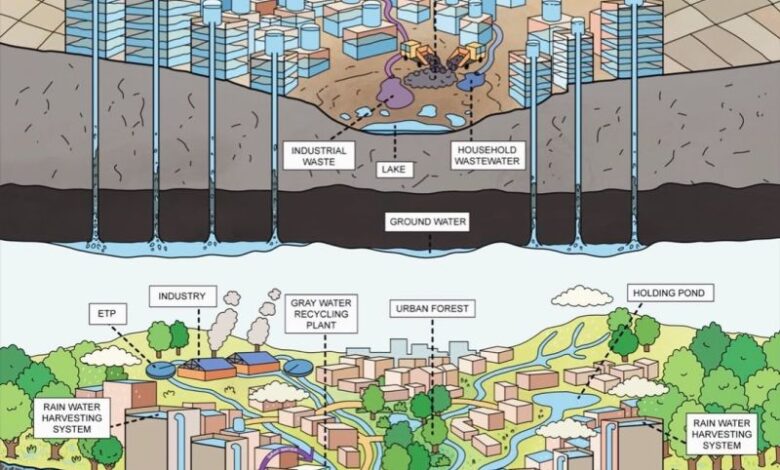
The Living City: Moving Beyond Extractive Urbanism
For the last two centuries, the unspoken design philosophy of the modern city has been simple: extract, consume, and discard.
We build urban centers like concrete funnels. They reach deep into the earth to drain underground aquifers and siphon distant rivers faster than nature can replenish them. Once used, that water is flushed away polluted, wasted, or trapped under a gray shroud of asphalt, rushing straight into storm drains rather than returning to the soil.
But as explosive population growth, punishing heatwaves, and water-hungry industries including the massive cooling demands of AI data centers place unprecedented stress on freshwater systems, this model is hitting a hard wall. We are trapped in a bizarre paradox where the exact same city can suffer a catastrophic water shortage on Monday and a devastating flash flood on Wednesday.
The solution is not to hunt for more water. It is to entirely rewrite what a city is designed to do.
[The Parasitic City] ── Extract Water ──> Use ──> Pollute & Flush (Depletes Ecosystems)
[The Sponge City]    ── Capture Rain   ──> Filter ──> Recharge Soil (Restores Ecosystems)
The Tale of Two Cities
The difference between an unsustainable city and a resilient one comes down to how it treats a single raindrop.
- The Bad City is an extractor. It views water as a one-way commodity. Rain hits a concrete roof, shoots down a metal pipe, floods an asphalt street, picks up automotive oil, and dumps into a river as toxic runoff. The groundwater beneath the city dries up, causing the very land it stands on to sink.
- The Good City is a sponge. It treats water as a cyclical lifeline. It breathes with the seasons. When rain falls on a restorative city, the infrastructure goes to work, mimicking the natural water cycle through a network of green engineering:
| Infrastructure | How It Gives Back |
| Permeable Pavement | Allows water to breathe through the street and sink back into local aquifers. |
| Urban Forests & Rain Gardens | Act as natural retention bowls, slowing down stormwater while cooling the city grid. |
| Graywater Recycling & Holding Ponds | Filter wastewater from sinks and showers to water parks or flush toilets, slashing freshwater demand. |
The Sponginess Dividend: By absorbing, cleaning, and recharging water locally, a city naturally drops its flood risk, revives dying local ecosystems, lowers urban temperatures, and secures its own physical survival.
Designing for Coexistence
The future of urban planning cannot be an aggressive battle of concrete versus nature. It must be infrastructure working as nature.
A city shouldn’t be a parasite on the landscape, leaving a footprint of depletion wherever it expands. The cities that survive the next century will be the ones smart enough to restore what they take proving that humanity can build spaces that heal the planet, one raindrop at a time.
The Blueprint of a Restorative City
To see how these individual elements stitch together into a single, closed-loop urban ecosystem, look at how the layers interact:
- The Sky Layer: Green roofs and solar-paneled rainwater collectors catch heavy downpours before they ever hit the ground.
- The Surface Layer: Rain gardens, bioswales (vegetated ditches), and urban wetlands filter pollutants naturally using plant roots.
- The Subsurface Layer: Deep cisterns store filtered water for dry spells, while permeable soils slowly drip water back down to stabilize the water table.
source:
https://www.linkedin.com/posts/water-sustainability-climateaction-share-7473972005592117248-yCfL/


