
WALKABLE AND BIKEABLE CITIES
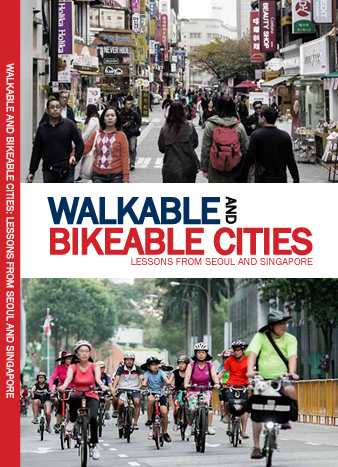
Walkability and bikeability have gained greater prominence in cities throughout the world in recent years. People, communities and governments are increasingly aware of the environmental, social and even economic benefits of such active mobility, and have begun to demand more walkable and bikeable places. Different Contexts, Common Goals Each city is driven by a unique set of circumstances to make its environment pedestrian- and cyclist-friendly. In Seoul, decades of serious traffic congestion are projected to chalk up to KRW 22 trillion in costs by 2030, a significant increase from KRW 7 trillion in 2008. The Seoul Transport Vision 2030 is a mobility paradigm shift that aims to create a people-centric transport system focusing on public transport, pedestrians and cyclists. It is underpinned by a comprehensive public transport system created through decades of investments in urban rail networks and a major bus system reform in 2004. This provides a viable alternative for people to move around the city through a combination of active mobility and public transport, without the need for private cars. Singapore has remained comparatively free of crippling traffic congestion, thanks to a robust system of integrated land use and transport planning, as well as car population and usage controls in place since the 1970s. However, Singapore’s population is steadily growing; and this, coupled with the citystate’s fundamental land scarcity, poses an obstacle to further growth. With 12% of Singapore’s land area already dedicated to land transport infrastructure—almost the same as that for housing at 14%—the need to further cut back the use of private cars has become more urgent, if Singapore is to continue growing in a sustainable manner. The car-lite vision, launched in 2015, is a key strategy under the Sustainable Singapore Blueprint, with walking and cycling as its important aspects. Beyond Mobility: Re-orienting the City to Its People Walking and cycling, however, is more than just moving around the city—walkable and bikeable cities are also often highly liveable cities. Traffic-calmed neighbourhoods, carfree streets and civic plazas created from active-mobility-related initiatives play a key role in enhancing quality of life. As evident in the cases covered in this publication, in promoting walking and cycling through the re-allocation of limited urban space from cars to pedestrians and cyclists, Seoul and Singapore are a step closer in becoming safe and vibrant cities for their people, thus generating wider benefits for more citizens.
source :
https://www.clc.gov.sg/docs/default-source/books/walkable-and-bikeable-cities.pdf?sfvrsn=d07e665a_2
Temukan peta dengan kualitas terbaik untuk gambar peta indonesia lengkap dengan provinsi.


