
Global drivers of change
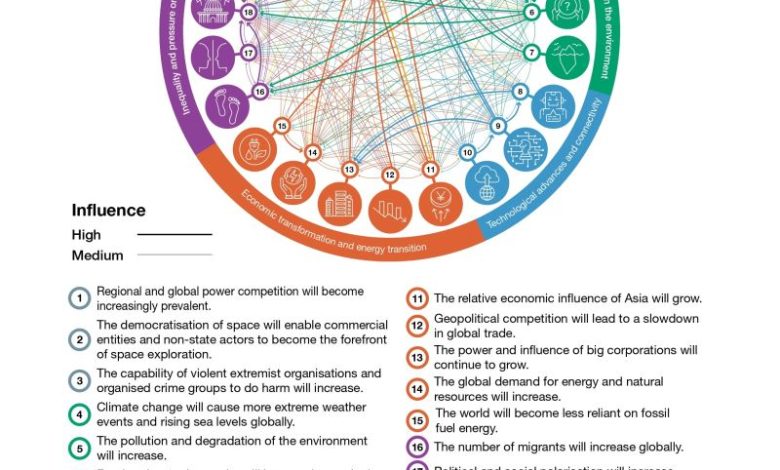
Understanding the key global drivers of change is essential to anticipate future developments in societies, economies, governance, and the environment. Six major interconnected drivers have been identified, each with underlying trends that may influence, counteract, or accelerate one another.
A summary of these drivers is outlined below:
Global Power Competition: Power dynamics will shift as major and smaller state and non-state actors compete for influence, affecting international relations and global stability.
Demographic Pressures: Population growth and aging will vary significantly by region, with rapid growth expected in parts of Africa and Asia, leading to increased migration and urbanization.
Climate Change and Environmental Pressure: More extreme weather events and environmental degradation will intensify, prompting stronger global efforts toward mitigation and adaptation.
Technological Advances and Connectivity: Rapid developments in AI, automation, and data analytics will transform industries and global power competition, reshaping economies and societies.
Economic Transformation and Energy Transition: The shift toward sustainable energy and new technologies will offer strategic advantages, though failure to adapt may lead to societal challenges.
Inequality and Governance Challenges: Rising inequality and concentrated wealth, combined with governance pressures, will exacerbate social tensions and strain existing systems.
These drivers will collectively shape the global landscape, influencing the trajectory of future developments.
The six global drivers of change are deeply interconnected, with each influencing and amplifying the others in complex and often unexpected ways. For instance, demographic pressures, such as population growth and migration, directly affect resource demand, which in turn intensifies the impact of climate change and environmental degradation.
Additionally, these drivers often create feedback loops. For example, technological advancements may accelerate economic transformation, but they can also widen inequality, which places pressure on governance structures. This strain can then lead to political instability, further complicating global power competition.
Climate change acts as a cross-cutting factor, influencing everything from migration patterns to technological innovation, making it a critical area of focus across all sectors. Understanding these interconnections is essential for navigating the challenges and opportunities that lie ahead.
source :


