ABC of sustainable & inclusive urban development
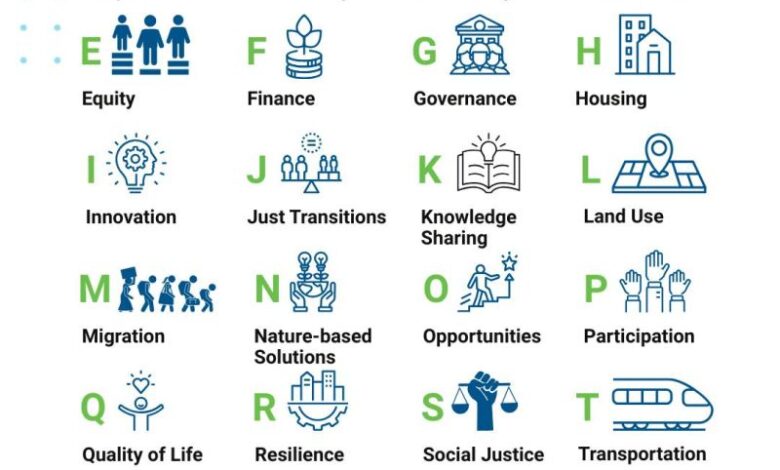
The concept of a Sustainable City has evolved far beyond green spaces and solar panels. According to the UN-Habitat ABC Framework, urban sustainability is a sophisticated “operating system” that integrates infrastructure, social equity, and biological resilience.
As over 50% of the global population now resides in urban centers, transforming these environments is the primary lever for achieving global climate goals.
1. The Environmental Core: Resilience & Regeneration
A sustainable city must act as a living organism that protects its inhabitants while regenerating its natural surroundings.
- Adaptation & Biodiversity: Shifting from “gray” infrastructure (concrete) to “green/blue” infrastructure. This involves creating “Sponge Cities” that use wetlands and permeable surfaces to manage flood risks and heat islands.
- Decarbonization: Eliminating the carbon footprint of urban life through electrified mass transit and net-zero building standards.
- Nature-Based Solutions (NbS): Integrating ecosystems like urban forests and rooftop gardens to provide natural cooling, air filtration, and mental health benefits for residents.
2. The Social & Economic Pillar: Equity by Design
Sustainability is impossible without Inclusion. A city that is “green” but unaffordable is not sustainable.
| Strategic Pillar | Focus Area | Impact |
| Equity & Access | Fair distribution of services. | Ensures that low-income communities have equal access to clean water, parks, and transit. |
| Inclusive Housing | Organized urban growth. | Prevents slum formation and ensures safe, affordable living spaces for all demographics. |
| Community Agency | Participatory planning. | Empowers citizens to co-design their neighborhoods, ensuring high “social capital” and resilience. |
3. The Structural Engine: Governance & Planning
To turn vision into reality, cities require “smart” skeletal structures data driven and transparent.
- Circular Land Use: Efficient zoning that prioritizes “15-minute city” models where work, food, and healthcare are within a short walk or bike ride.
- Zero-Waste Systems: Transitioning from “Take-Make-Dispose” to Circular Economy practices, where urban waste is harvested as a resource for energy (biogas) or materials (upcycling).
- Innovative Finance: Leveraging green bonds and public-private partnerships to fund large-scale resilient infrastructure, such as sea walls or renewable energy grids.
4. The Future Catalyst: Innovation & Youth
The trajectory of a city is determined by its ability to evolve. Knowledge Sharing between global cities (like the C40 network) allows for the rapid scaling of successful climate pilots. Furthermore, Youth Leadership is no longer a symbolic gesture; it is a mechanical necessity for long-term accountability, as the younger generation will inhabit the urban systems being built today.
Sustainable urban development is the art of balancing Economic Vitality with Environmental Protection. It is an ongoing process of creating cities where the “ABC” pillars from Adaptation to Zero Waste work in harmony to ensure that people and the planet can thrive in tandem.
source: