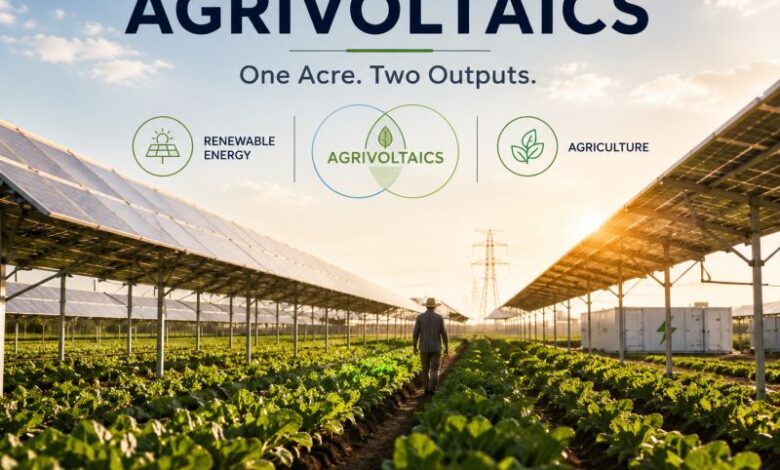
Agrivoltaics one acre, two outputs
The Dual-Crop Revolution: Why the Future of Solar is Growing Underneath It
For years, we’ve been told a lie about the clean energy transition: that we have to choose between feeding the planet and powering it.
It’s always framed as a zero-sum trade-off. If a developer rolls out rows of shimmering silicon solar panels across an acre of land, that’s one less acre of rich, productive soil growing corn, wheat, or grazing livestock. Energy wins; agriculture loses.
But what if a single acre of land could do both?
Enter agrivoltaics—the radical but entirely common-sense practice of co-locating solar panels and agriculture on the exact same footprint. It’s a model that stops treating land availability as a battlefield and starts treating it as an ecosystem. When we elevate solar arrays just a few feet higher, or space them a bit wider, something remarkable happens to the microclimate beneath them.
The relationship isn’t just cooperative; it’s symbiotic:
- Sunshield Efficiency: Instead of baking under a brutal midday sun, crops like leafy greens, berries, and even certain root vegetables get a reprieve. The partial shade reduces heat stress, actually boosting yields for shade-tolerant plants.
- The Atmospheric Sponge: Underneath the panels, the soil stays cooler. Evaporation rates plummet, meaning farmers can slash their water usage by up to 30% in arid regions.
- A Natural Air Conditioner: Solar panels actually lose efficiency when they get too hot. The moisture transpired by the plants below acts as a natural evaporative cooling system, keeping the panels running at peak electrical output.
- Economic Anti-Fragility: For landowners, this turns a volatile farming business into a diversified powerhouse. One acre yields two distinct revenue streams: a predictable monthly check from the electrons pushed to the grid, and a seasonal harvest from the dirt.
As the energy transition shifts into high gear, our biggest bottleneck isn’t technology or capital—it’s space. We are running out of easy acreage.
The next phase of renewable energy cannot be about manifest destiny, occupying more and more land until there’s nothing left. It has to be about intelligence. It’s about making every single acre work twice as hard.
Agrivoltaics isn’t just a niche alternative for quirky farms. It is the blueprint for how we reconcile our hunger for energy with our need to protect the earth. The future of solar isn’t a sterile desert of glass and steel; it’s a living, breathing green field.
Why this rewrite works harder:
- It creates a villain (and a hero): By framing the old way as a “zero-sum lie,” it gives the reader a narrative hook to lean into.
- It explains the why visually: Instead of just listing bullet points, it highlights the symbiosis (e.g., how the plants actually help the panels stay cool).
- It uses punchier language: Swapping “additional revenue” for “economic anti-fragility” and “lower evaporation” for “the atmospheric sponge” elevates the writing from a textbook to a thought-leadership piece.
How do you want to use this piece? We can tweak the angle to focus more heavily on the financial numbers for farmers, or lean closer into the environmental policy side depending on your audience.
source: