China has developed a bamboo based plastic
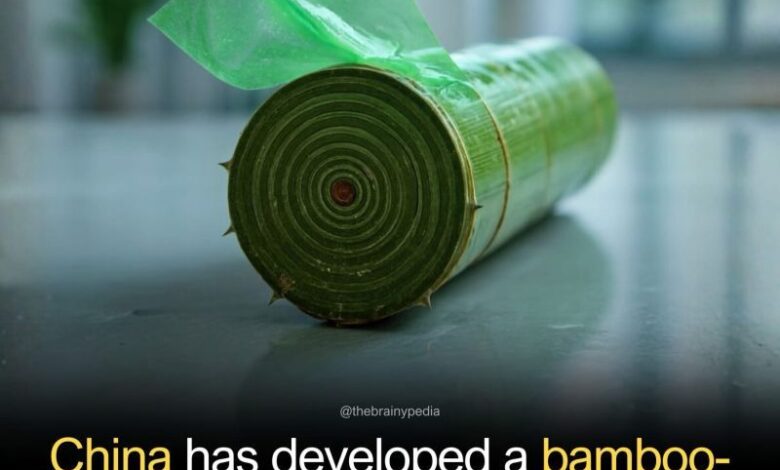
For nearly a century, we have engineered materials designed to last forever, only to use them for minutes. China’s recent breakthrough in High-Performance Bamboo-Based Plastic flips this destructive logic. We are no longer talking about flimsy straws; we are witnessing the birth of a structural material that matches the strength of petroleum polymers but vanishes back into the earth in less than two months.
This is not just a “green alternative” it is a biochemical disruption of the global supply chain.
The Engineering of a “Natural Synthetic”
The brilliance of this innovation lies in harnessing the natural lignocellulose of bamboo. Through advanced pulping and molding technologies, researchers have created a material that achieves:
- Tensile Strength Equivalence: It competes with conventional plastics in industrial applications, from packaging to lightweight automotive components.
- The 50-Day Lifecycle: Unlike “compostable” plastics that require industrial heat, this bamboo-based material is designed for rapid biodegradation in natural soil conditions, leaving zero microplastic residue.
- Carbon Negativity: Bamboo is one of the fastest-growing carbon sinks on the planet. Utilizing it as a feedstock turns a carbon-emitting industry into a carbon-sequestering one.
From Fossil Dependency to Regenerative Manufacturing
The strategic implications of “Bamboo-as-Plastic” extend far beyond environmentalism; they are rooted in economic sovereignty.
1. Decoupling from Oil
Global plastic production consumes roughly 8–10% of global oil. By shifting to bamboo, nations can stabilize their material costs, decoupling them from the volatility of Brent Crude and geopolitical tensions.
2. The Tropical Belt Advantage
Countries like Indonesia and India, possessing vast, underutilized bamboo resources, are sitting on the “oil fields” of the 21st century. This innovation allows for localized manufacturing, reducing the massive carbon footprint of global shipping.
3. Circularity by Design
In a true circular economy, the “end-of-life” is the beginning of the next cycle. A bamboo-based crate that breaks down in 50 days becomes the fertilizer for the next bamboo grove.
The Strategic Scaling Challenge
The transition from a “lab miracle” to a “market standard” requires more than just good science. It demands:
- Policy Parity: Taxing virgin petroleum plastics to reflect their true environmental cost.
- Infrastructure Investment: Building regional “Bio-Refineries” near bamboo-rich areas.
- Industrial Re-Tooling: Ensuring current plastic injection molding machines can handle bio-based resins with minimal modification.
We don’t have a plastic problem; we have a design problem. We have been using a “permanent” material for “temporary” problems. Bamboo-based plastic finally aligns the lifespan of the product with the lifespan of its purpose.
source: