Confused about GHG Carbon Calculations
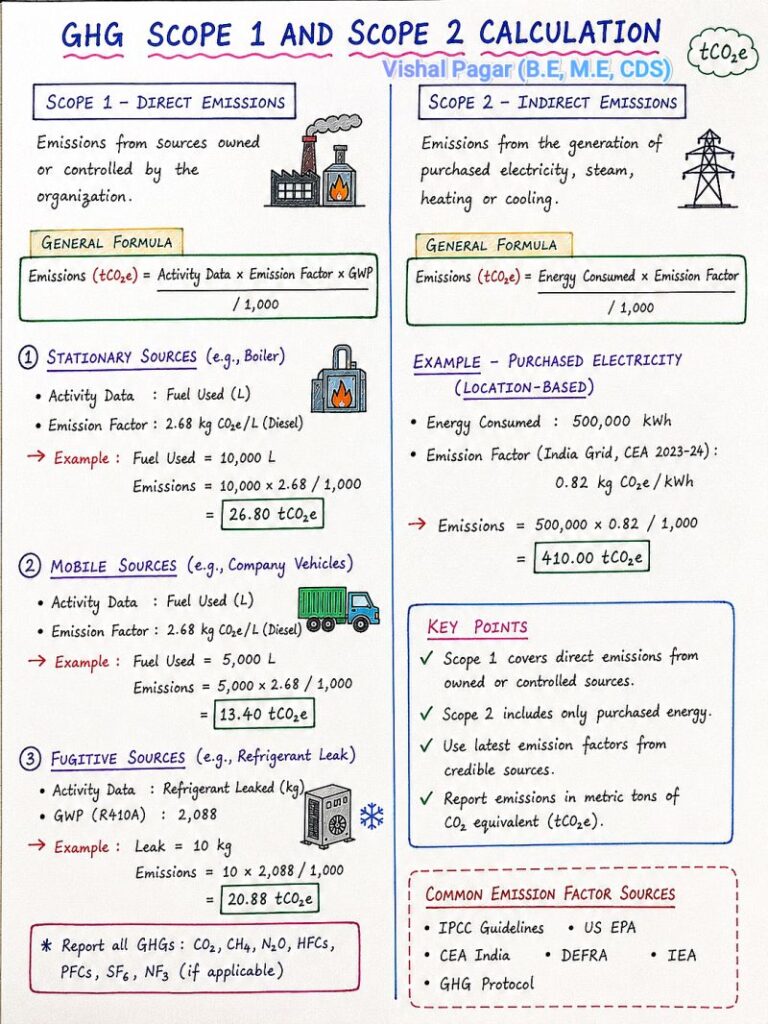
Confused about GHG Carbon Calculations❓🤷♂️ Most professionals know Scope 1 and Scope 2 but many still get the actual calculation wrong.
The easiest way to understand them is to separate direct emissions from purchased energy emissions.
Scope 1 = Direct emissions
These come from sources owned or controlled by the organization:
• Stationary combustion — boilers, furnaces, generators
• Mobile combustion — company vehicles
• Fugitive emissions — refrigerant leaks
✓ The basic calculation is:
Emissions (tCO₂e) = Activity Data × Emission Factor × GWP / 1,000
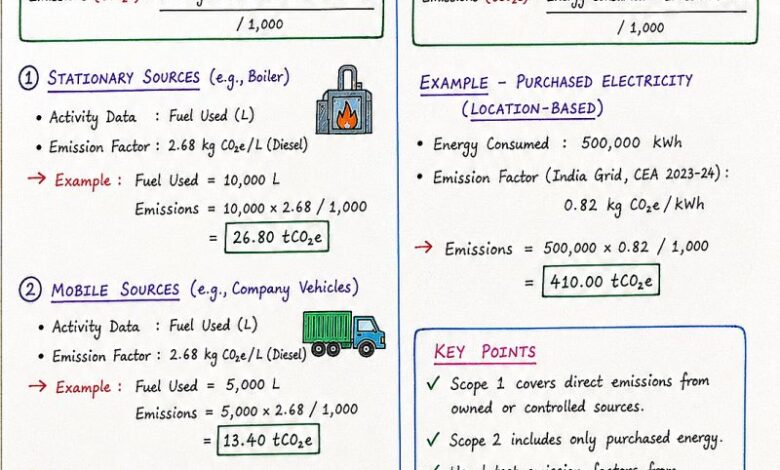
For example, if a boiler consumes 10,000 L of diesel at 2.68 kg CO₂e/L:
10,000 × 2.68 / 1,000 = 26.80 tCO₂e
✓ Scope 2 = Indirect emissions from purchased energy
This primarily covers emissions associated with purchased:
Electricity
Steam
Heating
Cooling
✓ For purchased electricity:
Emissions (tCO₂e) = Energy Consumed × Emission Factor / 1,000
Example:
500,000 kWh × 0.82 kg CO₂e/kWh ÷ 1,000
= 410 tCO₂e
A few practical points matter when preparing a corporate GHG inventory:
✓ Use activity data that can be traced to reliable records.
✓ Select emission factors from credible and current sources.
✓ Apply the appropriate GWP values for the relevant gases.
✓ Don’t overlook fugitive emissions such as refrigerant leakage.
✓ Report emissions consistently in metric tonnes of CO₂ equivalent (tCO₂e).
Understanding the formula is simple.
The real challenge is choosing the right activity data, emission factor, boundary, and calculation methodology.
✓ For practical sustainability and ESG, Carbon footprint, and LCA masterclass courses: visit: 365sustainability.com
• Follow Vishal Pagar for more content