Green and thriving neighbourhoods: a pathway to net zero, featuring the ‘15-minute city’

As urban populations swell, the path to a sustainable future hinges on building compact, resilient, and well-connected communities. This isn’t just an ideal; it’s our most powerful strategy to curb greenhouse gas emissions, conserve precious global resources, and protect fragile biodiversity.
Local projects, scaled down to the neighborhood level, offer a crucial advantage: they act as urban test beds. Here, we can trial groundbreaking approaches in design and construction, leverage cutting-edge technology, and, most importantly, foster the positive engagement and participation of citizens and communities. These living laboratories allow us to refine strategies before deploying them on a wider scale.
A Global Blueprint for Net-Zero Neighborhoods
A new guidebook, available in both English and Chinese, underscores the vital importance of an integrated approach and decisive neighborhood action in confronting the climate crisis head-on. It provides a robust framework for city governments, guiding them on how to achieve net-zero emissions at the neighborhood scale. What’s truly remarkable is its versatility: this framework can be applied to both brand-new developments and existing neighborhoods worldwide.
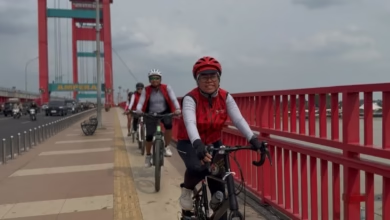
Drawing inspiration from best practices and successful projects in pioneering cities across the globe, the guidebook outlines ten key approaches. These approaches, when implemented collectively, have the power to transform urban areas into vibrant, green, and thriving neighborhoods. A central tenet among them is the creation of 15-minute cities – an urban planning principle designed to ensure that all essential amenities are within a 15-minute walk or bike ride from residents’ homes, dramatically improving accessibility and inclusivity for everyone.
The ten approaches are thoughtfully categorized into three core areas:
1. The 15-Minute City: Designing for People
This category reimagines urban living by prioritizing proximity and convenience. It encompasses:
- Complete neighborhoods: Creating self-sufficient communities where daily needs are met locally.
- People-centered mobility: Shifting focus from cars to pedestrians, cyclists, and public transport.
- Connected places: Fostering strong links between different parts of the neighborhood.
- A place for everyone: Ensuring equitable access to amenities and opportunities for all residents.
To illustrate, London’s Haringey Council transformed the previously vacant Blue House Yard site into a hub of affordable workspaces for small businesses, complemented by vibrant public spaces. This adaptable environment caters to diverse residents and cultivates a lively local atmosphere. Similarly, Barcelona’s Superblocks program has revolutionized urban mobility by using temporary street furniture, tree planters, and painted road markings to prioritize pedestrians and cyclists. The first Superblock successfully reduced the area occupied by cars by an impressive 48%, while simultaneously boosting economic activity at street level.
2. Clean and Green: Sustainable Foundations
This category focuses on the environmental footprint of construction and resource management:
- Clean construction: Implementing sustainable building practices that minimize environmental impact.
- Green buildings and energy: Designing energy-efficient buildings powered by renewable sources.
- Circular resources: Embracing principles of reuse, recycle, and reduce to minimize waste.
Consider the Collective for Climate Project in Paris’ La Porte de Montreuil neighborhood. This ambitious initiative aims to slash operational and embodied emissions by 85% and mandates that all buildings must be adaptable or reversible, ensuring long-term sustainability. In Milan, L’Innesto is poised to become Italy’s first “Zero Carbon Housing Sociale” district. It features an innovative neighborhood heating system fueled by renewable sources, including urban wastewater heat-recovery, and is comprised entirely of Nearly Zero Energy Buildings.
3. Sustainable Futures: Nurturing a Resilient Tomorrow
This category looks at broader ecological and economic strategies for long-term well-being:
- Green and nature-based solutions: Integrating natural elements to enhance urban ecosystems and resilience.
- Sustainable lifestyles: Encouraging eco-conscious behaviors among citizens.
- Green economy: Fostering economic activities that are environmentally sound and socially inclusive.
Medellín’s Corredores Verdes (Green Corridors) exemplify the power of nature-based solutions. This interconnected network of greenspace has effectively reduced the impact of urban heat, seen the planting of over 8,800 trees, and, remarkably, provided training opportunities for 75 citizens from disadvantaged backgrounds to become city gardeners. In Helsinki, the Kalasatama district stands as a beacon of smart urban development and a true climate pioneer. Instead of merely procuring goods and services, the City actively sought innovative pilot projects, empowering new businesses to develop novel ideas in collaboration with citizens, thereby embedding co-creation at the heart of this intelligent ecological district.
Your City’s Pathway to a Greener Future
The guidebook meticulously explains the meaning behind each of these approaches and provides practical advice on how cities can develop a clear pathway for their implementation – from preparing a project to comprehensive planning for its execution.
By initiating with low-cost interventions at a neighborhood scale, cities can build crucial momentum. This incremental success not only supports city-wide emission reduction targets but also acts as a magnet for funding and investment in larger, more ambitious projects. The authors of this transformative guidebook have also extended a powerful call to action to stakeholders and cities across the globe. They are urging communities to identify suitable neighborhoods that are ready to embrace this “green and thriving neighborhoods” model and serve as catalysts for climate action at the city, national, or even international level.
source: