Impact of climate change on the SDGs
Climate Change Doesn’t Threaten One SDG at a Time It Challenges the Entire System
“Climate change is not simply an environmental crisis. It is a multiplier of risks that can undermine decades of progress toward sustainable development.”
When discussing the United Nations Sustainable Development Goals (SDGs), it is common to examine each goal individually ending poverty, improving health, achieving food security, protecting biodiversity, ensuring clean water, or promoting sustainable cities. In reality, however, the SDGs were never designed to operate in isolation. They form an interconnected framework in which progress in one area often depends on progress in many others. Climate change exposes this interdependence more clearly than almost any other global challenge. It does not affect one Sustainable Development Goal at a time. Instead, it triggers a cascade of environmental, social, and economic impacts that ripple across multiple goals simultaneously. Understanding these cascading effects is becoming one of the most important skills for sustainability professionals, policymakers, businesses, and investors.
Climate Change Is a Systems Challenge
Climate change is often described through individual indicators: rising temperatures, stronger storms, sea-level rise, melting glaciers, or warming oceans. Yet these are only the starting points. Each climate impact sets off a chain reaction that extends far beyond the natural environment. A warmer climate reduces agricultural productivity. Lower crop yields increase food prices. Higher food prices worsen poverty and malnutrition. Poor nutrition contributes to declining public health. Economic stress increases migration pressures and social instability. Governments face higher costs for disaster response while infrastructure becomes increasingly vulnerable. One environmental change rapidly evolves into challenges affecting healthcare, education, employment, economic growth, and governance. Climate change therefore behaves less like a single crisis and more like a network of interconnected risks.
Rising Temperatures Affect Far More Than Weather
Increasing global temperatures represent one of the most visible consequences of climate change. However, their impacts extend well beyond hotter summers. Heat stress reduces labor productivity, particularly for outdoor workers in agriculture, construction, and manufacturing. Higher temperatures reduce crop yields and fisheries productivity while increasing water demand and evaporation. Droughts become more frequent in vulnerable regions, placing additional pressure on freshwater resources. Food insecurity grows as agricultural production becomes less predictable. Communities facing repeated crop failures may experience rising poverty, displacement, and even conflict over increasingly scarce natural resources. Meanwhile, wildfires, forest degradation, and thawing permafrost can release additional greenhouse gases, creating feedback loops that accelerate further warming.
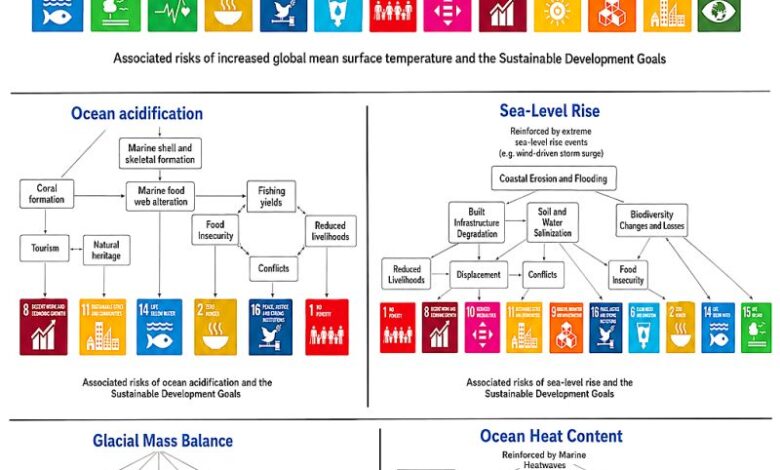
One climate driver influences multiple SDGs simultaneously from Zero Hunger (SDG 2) and Clean Water and Sanitation (SDG 6) to Good Health and Well-being (SDG 3), Climate Action (SDG 13), and Peace, Justice and Strong Institutions (SDG 16).
Ocean Acidification Threatens Food Security and Coastal Economies
The ocean absorbs roughly a quarter of global carbon dioxide emissions. While this moderates atmospheric warming, it also changes seawater chemistry, making oceans increasingly acidic. Ocean acidification weakens corals, shellfish, and other marine organisms that depend on calcium carbonate to build their skeletons and shells. As coral reefs decline, marine biodiversity falls and fisheries become less productive. For millions of coastal communities, declining fish stocks threaten livelihoods, nutrition, and local economies. Tourism dependent regions may also experience significant economic losses as coral reefs the foundation of many coastal tourism industries continue to deteriorate. A chemical change in seawater ultimately affects employment, economic resilience, biodiversity, and food security.
Rising Seas Reshape Communities
Sea-level rise is often portrayed as a distant concern. For many coastal communities, it is already a present reality. Higher sea levels increase the frequency and severity of coastal flooding, accelerate shoreline erosion, and allow saltwater to contaminate freshwater aquifers and agricultural soils. Infrastructure such as roads, ports, wastewater systems, and housing becomes increasingly vulnerable. As coastlines retreat, entire communities may be forced to relocate, creating complex social, economic, and governance challenges. Urban areas receiving displaced populations face additional pressure on housing, healthcare, transportation, education, and employment. Sea-level rise therefore affects not only ecosystems but also urban planning, infrastructure investment, disaster risk reduction, and social enquity.
Melting Glaciers Affect Billions of People
Glaciers function as natural freshwater reservoirs, gradually releasing water that supports rivers, agriculture, hydropower generation, and drinking water supplies. As glaciers lose mass, river systems initially experience increased flooding before eventually facing declining water availability. Communities downstream may encounter water shortages, reduced agricultural productivity, declining hydropower potential, biodiversity loss, and increased competition for freshwater resources. In addition to ecological impacts, glacier retreat threatens cultural heritage, tourism, and mountain economies that have depended on these landscapes for generations.
Warming Oceans Change Entire Marine Ecosystems
The ocean has absorbed more than 90% of the excess heat generated by global warming. While this has slowed atmospheric warming, it has fundamentally altered marine ecosystems. Marine heatwaves have become more frequent and intense. Coral bleaching events now occur across many tropical reef systems. Warmer waters hold less dissolved oxygen, contributing to ocean deoxygenation and placing additional stress on marine life. Fish populations shift toward cooler waters, affecting fisheries that coastal communities have relied upon for centuries. The consequences extend from biodiversity conservation to employment, nutrition, trade, and regional economic development.
Why Systems Thinking Matters
Traditional approaches often address sustainability challenges individually. One department focuses on water. Another addresses energy. Another manages biodiversity. Another develops climate strategies. However, climate change does not recognize organizational boundaries. Its impacts cut across environmental, economic, and social systems simultaneously. This is why systems thinking has become one of the defining competencies in sustainability. Rather than solving isolated problems, systems thinking examines how different risks interact, reinforce one another, and create cascading consequences across entire organizations and societies. Understanding these relationships enables better decision-making, stronger risk management, and more effective long-term planning.
What This Means for Businesses
For organizations, climate change is no longer solely an environmental issue. It is a strategic business issue. Physical climate risks can disrupt supply chains, reduce agricultural production, damage infrastructure, increase insurance costs, affect workforce productivity, and reshape consumer demand. At the same time, transition risks including evolving regulations, investor expectations, carbon pricing, and changing market preferences are transforming competitive landscapes across nearly every industry. Organizations that understand how climate risks intersect with the SDGs are better positioned to identify vulnerabilities, prioritize investments, strengthen resilience, and create long-term value. Sustainability is no longer about managing individual environmental indicators. It is about understanding the relationships between natural systems, economic systems, and human well-being.
The SDGs Rise or Fall Together
Perhaps the most important lesson is this:
The Sustainable Development Goals are not seventeen separate ambitions. They are one interconnected vision for a resilient and equitable future. When climate change disrupts food systems, it also affects health. When water becomes scarce, economies suffer. When biodiversity declines, livelihoods disappear. When communities are displaced, inequality often increases. Progress on one goal increasingly depends on progress across many others. Climate action, therefore, is not simply SDG 13. It is an enabling condition for achieving nearly every Sustainable Development Goal. The future of sustainability will belong to those who can see these connections not as isolated challenges, but as parts of one living system.
source:
https://www.linkedin.com/feed/update/urn:li:activity:7489895788010041344/