Plastic pollution & waste management
The True Cost of Convenience
Plastic has built the modern world. Its durability protects medical supplies, its lightness slashes transport emissions, and its versatility keeps food safe. But because we treat it as infinite and cheap, its lifecycle has broken down into a dangerous loop:
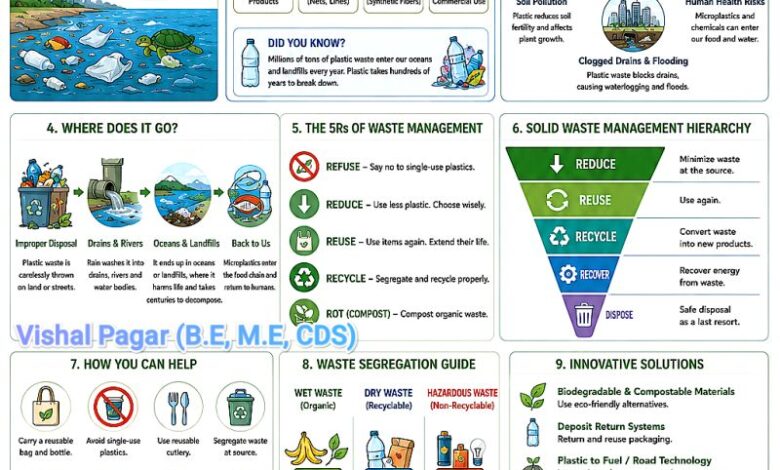
Improper Disposal ➔ Storm Drains & Rivers ➔ Marine Ecosystems ➔ Fragmented Microplastics ➔ The Human Food Chain
This structural failure impacts everything from infrastructure to biology:
- The Microplastic Mirror: Microplastics have infiltrated the deepest ocean trenches, remote mountain snowfall, and inevitably, our own bodies. We are quite literally consuming the ghost of our own discarded packaging.
- The Infrastructure Strain: In urban centers across the developing world, plastic waste routinely chokes drainage systems. A heavy rainstorm that should be a minor inconvenience instead becomes a catastrophic flood because the city’s veins are clogged with single-use bags and bottles.
Flipping the Hierarchy: Design Out, Don’t Just Recycle
For decades, the public was taught that recycling was the silver bullet. But recycling is actually an emergency brake, not the steering wheel. True circularity requires spatial and material rethinking long before a product ever hits a consumer’s hand.
[ Highest Priority ]  1. Prevention (Design it out entirely)
                             ↓
                      2. Reuse & Refill Models
                             ↓
                      3. Recycle & Upcycle
                             ↓
[ Lowest Priority ]   4. Safe Disposal & Recovery
The real shift happens when we transition from a linear “take-make-waste” mindset to a closed-loop system:
| Strategy | The Linear Approach | The Circular Upgrade |
| Packaging | Create cheap, non-recyclable multilayer films. | Shift to monomaterials or compostable seaweed-based alternatives. |
| Accountability | The consumer is solely responsible for disposal. | Extended Producer Responsibility (EPR)—companies fund the collection and recycling of their own packaging. |
| Retail | Single-use plastic bottles dominate the shelves. | Deposit Return Systems (DRS) where containers are treated as permanent assets returned for cash. |
True sustainability does not mean reverting to the stone age; it means entering the design age. The moment we stop treating plastic as a disposable nuisance and start treating it as a precious, high-value asset, we stop managing a pollution crisis and start managing a resource economy.
source: