
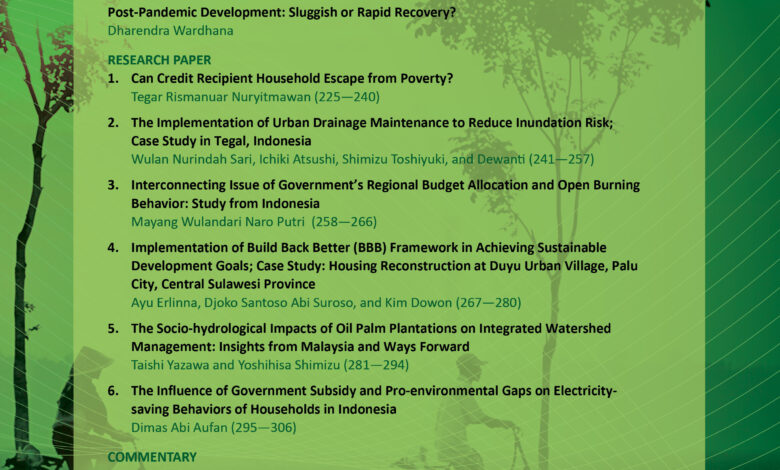
The influence of government subsidy and pro-environmental gaps on electricity-saving behaviors of households in Indonesia
The Subsidy Trap and the Intention Gap: Decoding Household Energy Consumption in Indonesia
Indonesia’s path to energy efficiency is blocked by two invisible barriers: a financial safety net that encourages waste and a psychological divide between “caring” about the environment and “acting” for it. By analyzing SUSENAS data through the lens of behavioral economics, we uncover why traditional awareness campaigns are failing and why subsidy reform is no longer optional.
1. The “Moral Hazard” of the Electricity Subsidy
The empirical evidence is clear: Subsidies are a double-edged sword. While they protect low-income households, they simultaneously act as a financial “blindfold” that obscures the true cost of energy.
- The Findings: Households receiving electricity subsidies are statistically less likely to engage in daily energy-saving behaviors.
- The Economic Friction: When the marginal cost of leaving a light on is negligible, the incentive for conservation vanishes. The subsidy effectively creates a “moral hazard,” where the government inadvertently finances energy inefficiency.
Strategic Shift: Subsidy reform must transition from a “blanket discount” to a “performance-based incentive.”
2. Bridging the “Value-Action” Gap
One of the most striking revelations of this research is the disconnect between what Indonesians think and what they do.
- The Myth of Intention: High pro-environmental intention (awareness) does not translate into lower meter readings. Simply “knowing” that saving energy is good for the planet is insufficient to change habits.
- The Power of Routine: Conversely, households with established pro-environmental routines (automated habits) are significantly more successful at conservation.
Environmentalism in Indonesia is currently aspirational, not operational. We are winning the “hearts and minds” but losing the “hands.”
3. The Behavioral Blueprint for Energy Management
To move the needle on national energy goals, the Indonesian government must look beyond infrastructure and address the Internal Gaps of its citizens.
Proposed Policy Interventions:
| Challenge | Traditional Approach | Behavioral Approach (Recommended) |
| Price Insulation | Blanket Subsidies | Tiered Pricing: Subsidies that diminish as consumption exceeds a “baseline” efficiency level. |
| The Intention Gap | Awareness Campaigns | Nudges: Real-time feedback via smart meters or “social proof” (comparing usage to neighbors). |
| Habit Formation | Occasional Tips | Default Settings: Promoting energy-efficient appliances and “set-and-forget” automation. |
4. Conclusion: From Awareness to Action
The findings suggest that Indonesia’s energy future depends on a dual-track strategy. We must reform the External Factors (subsidies) that discourage thrift, while simultaneously creating programs that mitigate the Internal Gaps between intention and act.
Environmental management is no longer just about the grid; it is about the household. We must stop asking Indonesians to care more and start helping them act better by turning conservation from a conscious choice into an unconscious routine.
source:
https://journal.pusbindiklatren.bappenas.go.id/lib/jisdep/article/view/88


