What Happens When Circular Economy Goals Become Law?
Thirteen years is the amount of time it took for Europe’s circularity rate to move from 10.7 percent to 11.8 percent. That is not even a single percentage point in thirteen years of policy, pledges, and action plans.
This admittedly uninspiring number, confirmed by the European Commission’s own monitoring data, is the reason the regulatory agenda shifted gear. What has replaced the prior voluntary approach is binding legislation that will touch almost every manufactured product sold in Europe by the end of this decade.
If you work in product design, procurement, packaging, textiles, electronics, or construction, you need to understand these new regulations. This is all the more important, because the first wave of hard deadlines has already passed and the next ones are approaching fast.
What the EU Is Actually Trying to Do
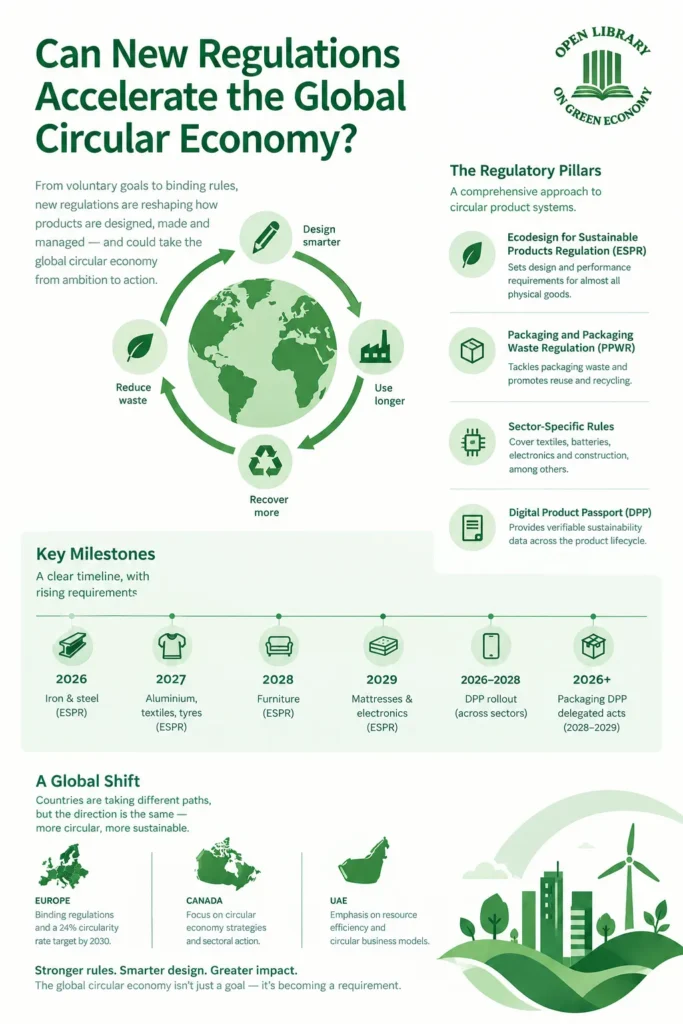
The EU wants to double its circularity rate from around 12 percent to 24 percent by 2030. This target is part of the Clean Industrial Deal, which is the EU’s plan to boost industrial competitiveness while cutting emissions. The centerpiece of this effort will be the Circular Economy Act, set for adoption in late 2026 to tie the existing regulations together.
In its August 2025 call for evidence, the Commission admitted that the circularity rate has barely budged despite fifteen years of work. They realized current rules will not work as intended without a true single market for recycled and recovered materials, which the new Act aims to create.
The global circularity rate, not just Europe’s, stood at 6.9 percent in 2025 according to the Circularity Gap Report. Europe at 12 percent is above the global average, but the ambition of doubling to 24 percent by 2030 requires a pace of change that has never been achieved in the fifteen-year history of this policy agenda.
Three main instruments hold all of this together: the Ecodesign for Sustainable Products Regulation, the Packaging and Packaging Waste Regulation, and a set of sector-specific rules covering textiles, batteries, electronics, and construction. Each one does a different job and together they form the most comprehensive product sustainability system any major economy has attempted.
The Ecodesign for Sustainable Products Regulation
The Ecodesign for Sustainable Products Regulation (ESPR) came into force in July 2024, and it forms the bedrock of the entire agenda.
It replaces the old Ecodesign Directive, which only applied to energy-related items, extending mandatory design rules to nearly all physical goods sold in the EU. Instead of writing every rule at once, the Commission will roll out sector-specific technical requirements progressively using delegated acts.
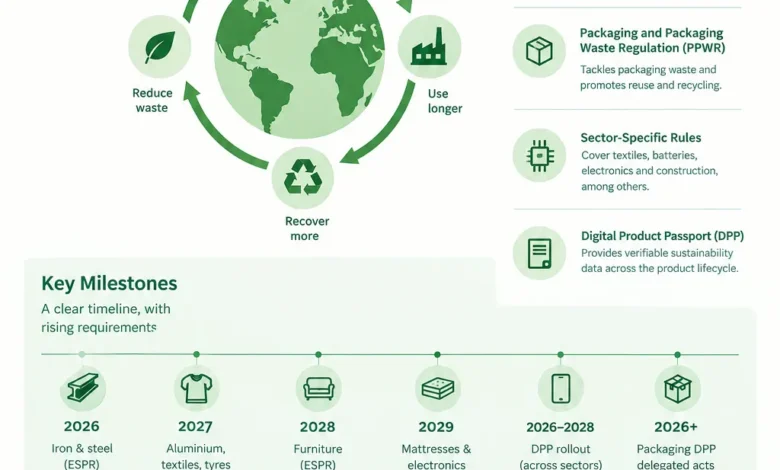
We already have the timetable through the 2025 to 2030 ESPR Working Plan. Iron and steel are up first in 2026, targeting emissions, energy efficiency, and overall resilience. Aluminum, textiles, and tires follow in 2027 with mandates on secondary materials, longer lifespans, and recyclability—the same year repairability rules hit electronics. Furniture comes next in 2028 to address resource use and environmental impact, before rules on durability, recyclability, and recycled content take effect for mattresses and electronics by 2029.
Starting in July 2026, the ESPR also bans large companies from destroying unsold textiles and footwear; a reprehensible fast-fashion tactic for managing excess inventory.
EC data shows that up to 80 percent of a product’s environmental footprint is determined during design. The logic then was to fix the design before manufacturing happens, rather than dealing with the waste later.
The Digital Product Passport
The Digital Product Passport (DPP) is the most significant piece of this puzzle. Launched in July 2026 via the EU DPP Registry, each passport is a machine-readable record carrying specific sustainability data, including material composition, substances of concern, recycled content, carbon footprint, repair guidance, and end-of-life options. Because it makes compliance verifiable at customs, market entry, and retail, the DPP acts as the core enforcement mechanism for all ESPR rules.
Rollout dates vary across sectors. GWP declarations for iron and steel begin in January 2026 under the revised Construction Products Regulation, with full DPP enforcement expected around 2027 to 2028. Draft technical requirements for textiles run through 2026, while DPP delegated acts for packaging are slated for 2028 to 2029. And if you manufacture outside the EU, these obligations apply equally the moment your goods hit the European market.
The Packaging and Packaging Waste Regulation
The Packaging and Packaging Waste Regulation (PPWR, Regulation EU 2025/40) entered into force on 11 February 2025 and applies directly across all EU member states starting 12 August 2026. Unlike the old Packaging Directive it replaces, there is no waiting around for national governments to write it into local law.
The core rule mandates that if you put packaging on the EU market, it has to be recyclable. Compliance gets scored on an A to E grading scale, with a minimum recyclability threshold of 70 percent taking effect by 2030, rising to 80 percent by 2038.
Some deadlines arrive faster. From 12 August 2026, food-contact packaging containing PFAS above set concentration limits has been banned entirely from the market.
By 2028, mandatory recyclability assessments using standardized EU criteria kick in, followed by binding recycled content targets for plastic packaging starting in 2030.
Packaging-specific Digital Product Passports—which tie back to the broader ESPR framework—are expected via delegated acts between 2028 and 2029. If you use multi-material packaging, you will have to characterize every single material layer separately. On top of that, Extended Producer Responsibility schemes are being standardized across the entire bloc, forcing producers to foot the bill for collecting, sorting, and recycling their own packaging.
To help businesses navigate these new guidelines, the EC published its formal implementation guidance on 30 March 2026.
The Right to Repair Directive
Since July 2024, the Right to Repair Directive grants consumers a formal legal right to choose repair over replacement whenever it’s technically feasible. Under these rules, manufacturers can no longer lock down their products—they have to supply spare parts, tools, and technical documentation to both independent repair shops and everyday consumers at reasonable prices. Intentionally designing items that can’t be fixed now carries legal and competitive consequences.
Textiles and Fashion
The textiles sector faces the most concentrated convergence of regulatory pressure of any sector right now.
The ESPR destruction ban from July 2026 eliminates unsold inventory incineration. EPR obligations from the 2025 amendment to the Waste Framework Directive require producers selling clothing in the EU to fund collection, sorting, and recycling of post-consumer textile waste. The DPP for textiles is being developed through 2026. REACH requirements on substances of concern apply at material level.
Regulatory elements cannot be managed separately anymore. Integrated product lifecycle management is becoming a compliance requirement, not a best practice choice.
Batteries
The Batteries Regulation, which was adopted in July 2023 in phased implementation, sets minimum recycled content requirements for lithium, cobalt, nickel, and lead in batteries. It also mandates explicit carbon footprint declarations and ramps up end-of-life collection and recycling targets over time. Battery Passports (which are a sector-specific form of DPP), are required for industrial, EV, and LMT batteries from 2026 to 2027.
The Circular Economy Act: What Is Coming
The Circular Economy Act is due for adoption in the fourth quarter of 2026. The public consultation ran from August to November 2025. A dedicated youth session was held at the European Circular Economy Stakeholder Platform conference in April 2026.
This Act will establish a Single Market for secondary raw materials, currently fragmented across 27 different national regulatory frameworks. It will set mandatory recycled content targets beyond what ESPR and PPWR already cover. It will also reform e-waste rules, and harmonise EPR schemes. Perhaps more importantly, it will also create public procurement preferences for circular products, deploying the purchasing power of the government to stimulate demand at scale.
What This Means If You Are Not in the EU
The EU’s regulatory reach extends beyond its borders through the following two mechanisms.
Market Access: If your product is sold in the EU, the ESPR, PPWR, and DPP requirements apply regardless of where it was made. Manufacturers in India, the UAE, Canada, or anywhere else exporting to European markets must comply.
Brussels Effect: When the EU sets standards of this specificity, global manufacturers often apply them universally rather than maintaining separate product versions eventually leading to the EU standard becoming the de facto global standard. This happened with GDPR and it is now happening with product sustainability.
How Canada and the UAE Compare
The EU is not the only jurisdiction moving in this progressive direction. Canada and the UAE are both advancing circular economy agendas, in their own region-specific ways instead of adopting the EU rulebook, and the differences are instructive.
Canada doesn’t have an equivalent to the ESPR or PPWR. Instead, it relies on a patchwork that sits far more at the provincial level than the federal one. Quebec led the way by passing Bill 29 in 2023, making it the first province to introduce right-to-repair laws that explicitly ban planned obsolescence, a tactic designed to shorten a product’s normal lifespan. By 2026, Quebec mandated that specific consumer electronics must be fixable using everyday tools. On the West Coast, British Columbia has run an industry-led Extended Producer Responsibility (EPR) system under its Recycling Regulation for years, expanding it through a Five-Year Action Plan running to 2026. Meanwhile, Manitoba shifted its packaging EPR to full producer responsibility starting in January 2026.
At the national level, the Circular Innovation Council released an updated Circular Economy Action Plan for Canada in 2025. This is a voluntary framework, not binding law. It is built around five enablers: public and business support, using circular strategies to address climate and biodiversity together, workforce skills, data access, and policy coordination. Canadian companies exporting to the EU still need to comply with ESPR and PPWR for those specific goods. Canada’s domestic framework remains its own, slower-moving, and more fragmented across provinces.
The UAE approach is centralised and policy-driven. The UAE Circular Economy Policy 2021 to 2031, issued by the Ministry of Climate Change and Environment, sets a national framework around four priorities: sustainable infrastructure, transport, manufacturing, and food production and consumption. A national Circular Economy Council, chaired by the Minister of Economy and Tourism, met in 2026 focused on governance frameworks and the food industry.
The most impactful part of the UAE’s plan is its phased ban on single-use plastics. Single-use plastic bags were banned in January 2024, followed in June 2024 by a ban on all single-use bags, including paper bags thinner than 50 microns. In January 2025, the ban extended to plastic stirrers, straws, and Styrofoam containers, before prohibiting plastic plates, cutlery, cups, and lids starting January 2026. The impact has been rapid: Dubai Municipality reported a 95 percent drop in single-use plastic bag consumption since the rules took effect.
That said, the UAE hasn’t introduced product-level ecodesign standards, a Digital Product Passport system, or explicit recycled content rules yet. While the plastics ban is strictly enforced and the broader policy vision is clear, the granular, product-by-product regulations building up in the EU aren’t here yet.
If you are a business navigating all three markets, your takeaway is straightforward: the EU demands the most intensive product engineering and technical data compliance, Canada requires you to track shifting state-by-state EPR and repair laws, and the UAE requires strict adherence to single-use material bans without the heavy product-redesign burden.
The Practical Checklist
For manufacturers and importers: Audit your packaging against PPWR recyclability standards today as packaging redesign carries long lead times. You also need to verify whether your food-contact packaging contains PFAS, and start building out your Digital Product Passport data infrastructure immediately.
For investors: Take a close look at portfolio exposure. Companies reliant on high packaging waste, those still destroying unsold inventory, or businesses heavily dependent on EU exports are now facing material regulatory liabilities, not just soft reputational risks.
For policymakers outside the EU: Harmonizing domestic product sustainability standards with ESPR and PPWR rules is the fastest way to save your home exporters from future market friction.
For sustainability practitioners: Even though the Circular Economy Act consultation has wrapped up, the real work happens during implementation. The Act provides the overarching framework, but the technical details that actually matter will roll out through delegated acts—and that is where deep regulatory understanding delivers the most value.
https://openlibrary.substack.com/p/what-happens-when-circular-economy