What turns a hazard into a disaster?
Nature is Neutral. Disasters are Human.
We have a habit of blaming the earth for our tragedies. We call them “natural disasters,” as if the tectonic plates or the wind speeds have a personal vendetta against us. But the truth is more uncomfortable: Nature provides the hazard; we provide the disaster.
A hurricane churning over the open Atlantic is a magnificent display of atmospheric physics but it isn’t a disaster. It only becomes one when it makes landfall on a coastline where we’ve paved over the wetlands that should have absorbed the surge.
The Equation of Ruin
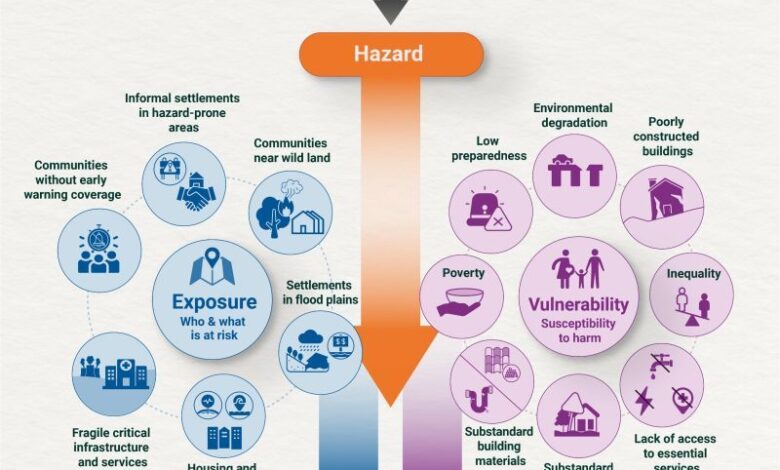
Disaster isn’t an accident; it’s a calculation. According to the United Nations Office for Disaster Risk Reduction, risk is the product of three colliding forces:
- The Hazard: The physical event (the fire, the flood, the quake).
- The Exposure: Who and what is standing in the way.
- The Vulnerability: The cracks in our armor poverty, weak infrastructure, and systemic inequality.
When a heatwave strikes a city, it doesn’t kill indiscriminately. It seeks out the neighborhoods without tree canopies, the elderly in buildings without cooling, and the workers in a healthcare system already pushed to the brink. This isn’t a “natural” tragedy; it’s a design flaw.
The Anatomy of Vulnerability
The infographic of our modern world reveals a difficult truth: our social failings act as force multipliers for nature’s power.
- Poverty is a Magnet: It pulls the marginalized into high-risk floodplains because that is the only land they can afford.
- Infrastructure as a Gamble: A “weak” building isn’t just an engineering failure; it’s a decision to prioritize short-term savings over long-term survival.
- The Silence of Systems: When an early warning system fails, or doesn’t exist, the loss of life isn’t a byproduct of the storm it’s a byproduct of neglect.
Choosing a Different Ending
Climate change is undoubtedly “tuning up the volume” on hazards, making them more frequent and more intense. But we aren’t helpless observers. If human decisions create risk, human decisions can dismantle it.
The future of resilience isn’t found in a crystal ball; it’s found in adaptation:
- Investing in Resilience: Building for the storm that is coming, not the one that happened fifty years ago.
- Nature as a Shield: Realizing that a healthy ecosystem is the most cost-effective “infrastructure” we have.
- Radical Equality: Strengthening social protections so that a person’s zip code doesn’t determine their survival rate.
The Bottom Line: We cannot stop the earth from moving, and we cannot command the wind to be still. But we can decide that a hazard will no longer be a death sentence. The disaster isn’t what falls from the sky it’s what we failed to do on the ground before it arrived.
source:
https://www.linkedin.com/feed/update/urn:li:activity:7458425983168073730/