How much waste do we really generate daily?
The Heavy Weight of Our Daily Discard
We tend to think of waste as something that disappears once it leaves our curb. But the “away” in “throwing it away” is a physical place and it’s getting crowded.
Every single day, you are the architect of a complex stream of leftovers. While a single piece of plastic might feel light in your hand, the collective weight of our modern lifestyle is a massive, invisible burden on the planet. Here is the daily “tax” we pay to the Earth, broken down by the numbers.
The Anatomy of Our Daily Discard
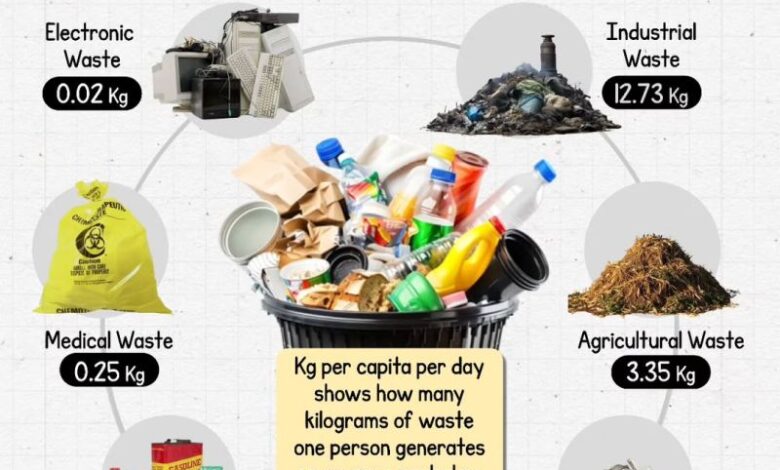
If we visualized our daily waste as a physical backpack we had to carry, here is what would be inside:
| Waste Category | Daily Weight (per person) | The Real-World Impact |
| Industrial | 12.73 kg | The hidden cost of everything we buy, from cars to clothes. |
| Agricultural | 3.35 kg | The husks, stalks, and spoiled yields of a global food system. |
| Construction | 1.68 kg | The debris of our ever-expanding urban footprint. |
| Municipal (Trash) | 0.74 kg | Your kitchen bin packaging, food scraps, and single-use items. |
| Hazardous | 0.32 kg | The “silent killers” paints, batteries, and chemicals. |
| Medical | 0.25 kg | The necessary but heavy price of modern healthcare. |
| Electronic (E-Waste) | 0.02 kg | Small in weight, but toxic in its heavy-metal legacy. |
The Hidden Giants: Industrial & Agricultural
Most of us focus on our kitchen trash, but the 12.73 kg of industrial waste is the true elephant in the room. This represents the energy, mining, and manufacturing waste generated to sustain our consumer habits.
Similarly, 3.35 kg of agricultural waste reminds us that for every meal that makes it to our table, several kilograms of organic matter often treated with pesticides and fertilizers are left behind, impacting soil health and water systems.
The Precision Threats: Toxins and Tech
While E-waste and Hazardous waste represent the smallest weights, they carry the highest “environmental toxicity” per gram.
- Electronic Waste: Contains lead, mercury, and cadmium that can leach into groundwater.
- Hazardous Waste: Requires specialized infrastructure to prevent long-term ecological disasters.
Reclaiming the Narrative: From Waste to Resource
This data shouldn’t lead to despair; it should lead to strategy. We are currently living in a “linear economy” (Take -> Make -> Waste). The goal is to shift toward a Circular Economy, where “waste” is simply a resource in the wrong place.
When you compost your food scraps, that 0.74 kg of municipal waste stops being a methane-producer in a landfill and starts being a carbon-sequestering fertilizer for the soil.
Your Daily Action Plan
Awareness is the spark, but systemic change is the fuel. You can lighten your daily “backpack” by:
- Demanding Transparency: Support industries that prioritize “Zero Waste to Landfill” certifications.
- The “Right to Repair”: Keep that 0.02 kg of e-waste out of the stream by fixing gadgets instead of upgrading.
- Closing the Loop: Compost at home or through a city program to turn your personal trash into planetary gold.
source: