Carbon Sequestration: A Hidden Engine of the Green Economy
Carbon sequestration is often reduced to a simple idea: planting trees. But the reality is far broader, more complex, and far more powerful for shaping a sustainable economy.
Tree planting is only one small part of a much larger system that supports global climate stability and economic resilience.
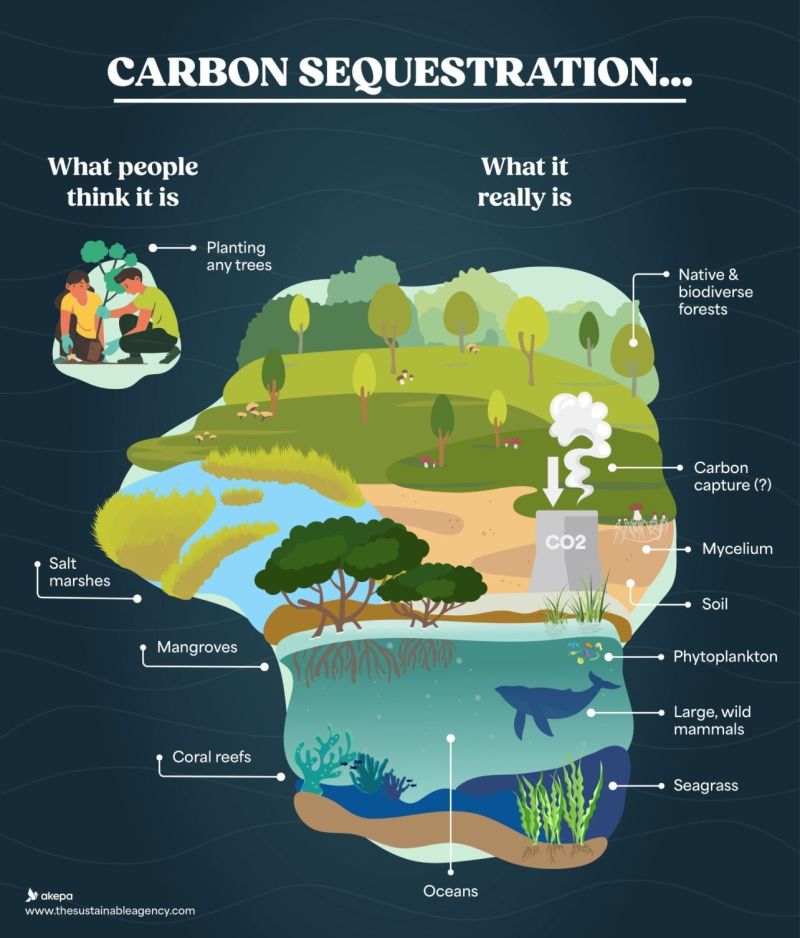
The true carbon sequestration landscape includes:
🌳 Protection of native, biodiverse forests
Intact forests store far more carbon than monoculture plantations and preserve long-term ecological balance.
🌊 Blue carbon ecosystems
Mangroves, salt marshes, and seagrass meadows act as highly efficient carbon sinks while also strengthening coastal protection and local economies.
🌱 Soil and regenerative systems
Healthy soils, regenerative agriculture, and microbial networks (including mycelium) store vast amounts of carbon while improving food production systems.
🐋 Ocean-driven carbon cycles
Phytoplankton and coral reef ecosystems play a crucial role in regulating global carbon flows and supporting marine-based economies.
🦌 Wildlife and ecosystem integrity
Large mammals and intact food webs help maintain carbon-rich landscapes through natural ecological interactions.
⚡ Technological carbon capture
Emerging carbon capture and storage technologies complement natural systems and expand mitigation capacity.
A resilient green economy depends on a combination of ecosystem protection, restoration, and technological innovation—not isolated solutions.
Carbon sequestration is not only an environmental necessity, but also a foundational pillar of long-term economic stability and climate resilience.
Strong ecosystems build strong economies.