
It’s not the heat, it’s the humidity
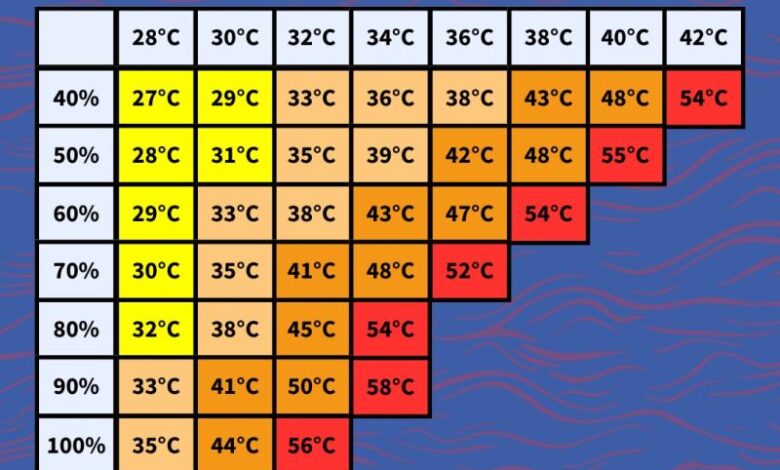
The Invisible Threshold: Where Heat and Water Turn Deadly
“It’s not the heat, it’s the humidity.”
We use that phrase to shrug off sticky summer afternoons. We say it to complain about bad hair days or damp shirts.
But as the planet warms, science is stripping that phrase of its casual comfort. The reality is far more clinical, and far more terrifying:
It is both. And together, they are a biological trap.
The Physics of Human Failure
Our bodies are magnificent thermal engines, but they have a hard limit. When we overheat, we sweat. As that sweat evaporates into the air, it carries heat away from our skin, keeping our internal organs functioning at a safe 37°C.
But this cooling mechanism relies on a fundamental law of physics: the air must have room to absorb our moisture.
When extreme heat collides with high humidity, the air becomes saturated. It refuses to take our sweat. The evaporative cooling system fails, and the heat we generate internally has nowhere to go.
At this threshold, heat stops being an outdoor inconvenience. It becomes a slow, internal boiling.
A thermometer reading of 34°C sounds manageable on paper. But wrap that same afternoon in suffocating humidity, and the heat index the “feels-like” reality rockets past 50°C. In these conditions, even a young, perfectly healthy person sitting in the shade with plenty of water can face heat exhaustion, heatstroke, and severe cardiovascular strain. Your heart pumps furiously, desperate to push heat to your skin, but the air suffocates the escape route.
Redefining the Threat
This is the new frontier of climate change. Global warming is not just shifting a needle on a dry desert gauge; it is supercharging the global water cycle, amplifying humidity, and weaponizing heatwaves.
We are moving into an era where cities were simply not designed for the atmosphere we have built. This shift forces us to rewrite the rules of modern society:
- The Labor Crisis: We must fundamentally change how, when, and if people can work outdoors.
- The Infrastructure Strain: Our power grids, already brittle, must withstand relentless, non-stop demand for cooling.
- The Urban Blueprint: We have to radically redesign architecture to shade and cool entire populations, rather than relying on individual air conditioning units.
The Survival Gap
For communities with wealth, this crisis will look like higher electricity bills. But for vulnerable populations those living without reliable cooling, steady power, or clean water—extreme heat is an existential threat. It is a quiet, highly predictable disaster that targets the elderly, the poor, and the marginalized first.
The future of climate adaptation cannot just be a clinical debate about emission percentages and policy targets. It must be an aggressive, immediate redesign of society for survival in a hotter, heavier world.
Because we are rapidly approaching a grim biological finish line. Soon, the question will no longer be: “How hot is it outside?”
The only question that will matter is: “Can a human being safely survive the air today?”
source:
https://www.linkedin.com/feed/update/urn:li:activity:7479055527801405440/


