How can cities reduce their carbon footprint?
Why the Future of Climate Action Will Be Designed, Not Declared
“The fight against climate change will not be won only in conference halls or international negotiations. It will be won—or lost—in the cities we build every day.”
By 2050, nearly 70% of the world’s population is expected to live in urban areas. This unprecedented wave of urbanization presents one of humanity’s greatest challenges—but also one of its greatest opportunities.
Cities occupy only a small fraction of the Earth’s surface, yet they are responsible for the majority of global economic activity, consume vast amounts of energy, and generate a significant share of greenhouse gas emissions. They concentrate people, industries, transportation systems, buildings, and infrastructure—all of which shape how resources are consumed and how carbon is emitted.
This means the future of climate action will not be determined solely by international agreements or national policies.
It will be determined by the neighborhoods we design, the buildings we construct, the transportation systems we prioritize, and the public spaces we choose to create.
In many ways, cities are both the source of the climate challenge and the key to its solution.
Urban Planning Is Climate Policy
Climate action is often associated with renewable energy, electric vehicles, or carbon markets. While these tools are important, one of the most effective climate strategies begins much earlier—with urban planning.
The physical layout of a city influences almost every aspect of daily life.
It determines whether people can walk to work or must drive long distances.
It influences whether public transport is convenient or impractical.
It affects how much energy buildings consume, how resilient neighborhoods are to floods and heatwaves, and how efficiently resources circulate through the local economy.
Every street, zoning decision, transit corridor, and public park represents a long-term climate decision that may shape emissions for decades.
Cities designed around people naturally consume fewer resources than cities designed around cars.
Building Compact and Connected Communities
One of the most effective ways to reduce urban emissions is not through technology alone but through proximity.
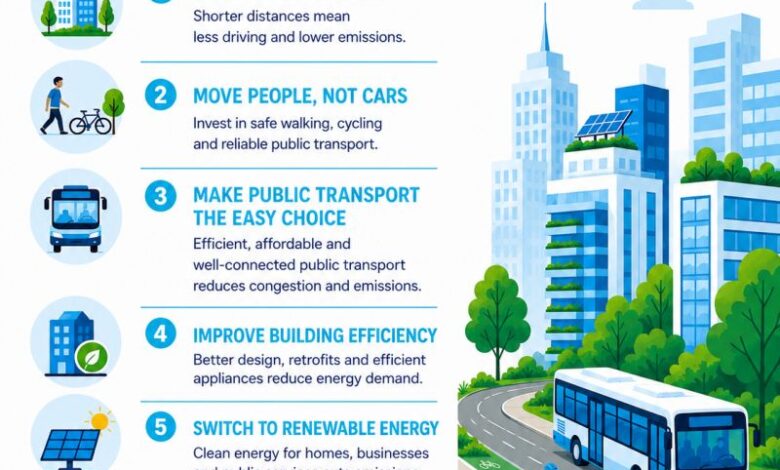
Compact, mixed-use neighborhoods allow residents to live closer to workplaces, schools, healthcare, shops, and recreational spaces. Instead of requiring long daily commutes, essential services become accessible within walking, cycling, or short transit distances.
This concept—often described as the 15-minute city—reduces transportation emissions while improving quality of life. It saves time, lowers household transportation costs, strengthens local businesses, and creates more vibrant communities.
The shortest journey is often the most sustainable one.
Designing Streets for People
For decades, many cities expanded road networks to accommodate growing numbers of private vehicles. While this increased mobility, it also encouraged car dependency, urban sprawl, air pollution, and congestion. The most successful cities of the future will prioritize people rather than traffic. Safe sidewalks encourage walking. Protected bicycle lanes make cycling practical for everyday travel. Accessible public spaces improve social interaction and public health. Public streets become places where communities gather—not merely corridors for moving automobiles. Every trip completed on foot or by bicycle reduces emissions while improving physical health and reducing noise pollution.
Public Transportation as the Backbone of Sustainable Mobility
No growing city can rely solely on private vehicles. Efficient public transportation allows thousands of people to move using far less space and energy than individual cars. Reliable buses, metro systems, light rail, and commuter trains reduce congestion, improve accessibility, and provide affordable mobility for residents regardless of income. When integrated with walking and cycling infrastructure, public transport becomes the foundation of an inclusive, low-carbon transportation system. The goal is not simply to move more vehicles. It is to move more people. Buildings That Consume Less Energy Buildings account for a substantial share of global energy consumption throughout their lifecycle. Poor insulation, outdated equipment, inefficient lighting, and excessive cooling demand increase both operating costs and greenhouse gas emissions. Climate-smart cities invest in energy-efficient building design, deep retrofits, passive cooling strategies, high-performance materials, smart energy management systems, and low-carbon construction practices. Every unit of energy saved is energy that never needs to be generated. Efficiency remains one of the fastest and most cost-effective climate solutions available.
Powering Cities with Clean Energy
Urban decarbonization also depends on transforming how cities generate and consume electricity. Expanding renewable energy—from rooftop solar panels and community solar projects to wind farms and clean electricity grids reduces dependence on fossil fuels while improving energy security. Electrification of buildings, transportation, and industry becomes far more effective when powered by renewable energy. The cleaner the grid becomes, the greater the climate benefits across every sector.
From Waste to Circular Cities
Modern cities generate enormous quantities of waste. Yet in a circular economy, waste is not viewed as an inevitable by-product but as a design challenge. Circular cities prioritize reducing material consumption, extending product lifespans, repairing instead of replacing, recovering valuable materials, composting organic waste, and transforming industrial by-products into new resources. Instead of asking how to dispose of more waste, circular cities ask how to prevent waste from being created in the first place. This shift reduces emissions, conserves natural resources, and strengthens local economic resilience.
Nature Is Essential Urban Infrastructure
Climate resilience is not built solely with concrete and steel. Trees, parks, wetlands, green roofs, rain gardens, rivers, and urban forests provide critical ecosystem services that engineered infrastructure alone cannot fully replace. Urban vegetation cools neighborhoods during heatwaves, improves air quality, absorbs stormwater, reduces flood risks, stores carbon, supports biodiversity, and enhances mental well-being. Nature-based solutions also make cities healthier, more attractive, and more resilient to the growing impacts of climate change. A city rich in green infrastructure is better prepared for a warmer future.
Climate Solutions Work Best Together
No single intervention will create a carbon-neutral city. Renewable energy alone cannot compensate for inefficient buildings. Electric vehicles cannot fully solve congestion or urban sprawl. Tree planting cannot offset unlimited emissions. Waste recycling cannot replace sustainable production and consumption. Real transformation occurs when these strategies reinforce one another. Compact neighborhoods reduce travel demand. Public transport lowers emissions. Energy-efficient buildings decrease electricity consumption. Renewable energy supplies clean power. Circular economy principles reduce material extraction and waste. Green infrastructure strengthens resilience against climate impacts. Together, they create cities that are cleaner, healthier, more competitive, and better prepared for future challenges.
Designing the Cities Future Generations Deserve
The cities we build today will shape the lives of billions of people for decades to come. Every new neighborhood, transit line, housing development, public park, and infrastructure investment represents a decision about the kind of future we want to create. The question is no longer whether sustainable cities are possible. Around the world, countless examples have already demonstrated that they are.
The real question is whether we can redesign our urban environments quickly enough to make low-carbon living not the difficult choice but the obvious one. Because the most successful cities of the future will not simply emit less carbon. They will also be healthier, safer, more inclusive, more resilient, and more prosperous places to live. Better cities are never accidental. They are the result of thoughtful planning, long-term vision, and the recognition that every street, every building, every tree, and every public space is an investment in the climate and in future generations.
source: