Types of Forest in the World
The Global Portfolio: Why All Forests Are Not Created Equal
We often talk about “planting trees” as a catch-all solution for climate change. But forests aren’t a monolith they are a diverse portfolio of specialized ecosystems. To protect the planet, we must understand the specific “services” each forest type provides and the unique risks they face.
The Four Pillars of Earth’s Life Support System
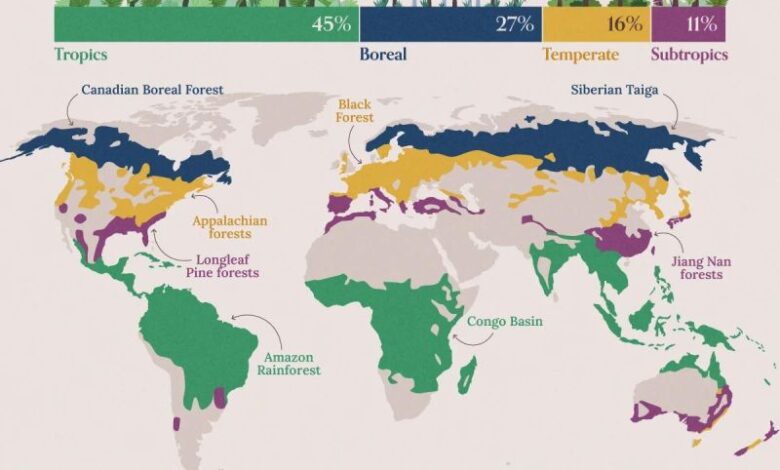
1. The Tropical Engine: High-Velocity Biodiversity (45%)
The Tropical Forest is Earth’s most active biological engine. Covering nearly half of our forested land, these systems are the “Lungs of the Planet,” but their real value is in their complexity.
- The Job: Massive carbon sequestration and the preservation of over 50% of the world’s terrestrial species.
- The Crisis: This engine is overheating. High deforestation pressures mean we are losing our most potent carbon-capture technology exactly when we need it most.
2. The Boreal Vault: The Great Northern Carbon Sink (27%)
The Boreal Forest (or Taiga) is a silent giant. Spanning the high latitudes of the Northern Hemisphere, these conifer-rich lands hold a secret: most of their carbon isn’t in the trees, but in the frozen soil and peat beneath them.
- The Job: Acting as a planetary thermostat and a massive, long-term carbon vault.
- The Crisis: Permafrost thaw and increasing wildfires are threatening to turn this “vault” into a source of emissions.
3. The Temperate Buffer: Resilience for the Modern World (16%)
Temperate Forests are the ecosystems closest to home for much of the global population. They are the masters of seasonal adaptation, cycling nutrients and managing water across four distinct seasons.
- The Job: Water filtration, local climate cooling, and providing a critical “buffer” between human industry and the natural world.
- The Crisis: Fragmentation. Urban sprawl is breaking these forests into small, isolated “islands” that cannot sustain high-level biodiversity.
4. The Subtropical Bridge: The Transition Zones (11%)
Found in the delicate space between the tropics and the temperate zones, Subtropical Forests are the adaptive generalists of the world, blending evergreen and deciduous species.
- The Job: Stabilizing transition zones against desertification and providing critical migratory corridors for wildlife.
The Strategic Takeaway: From “Trees” to “Systems”
If we treat forests like a commodity (timber), we lose. If we treat them like Strategic Infrastructure, we win.
| Forest Type | Primary Value | Key Climate Risk |
| Tropical | Biodiversity & Rainfall Generation | Land Conversion / Deforestation |
| Boreal | Soil Carbon Sequestration | Wildfires & Permafrost Melt |
| Temperate | Water Regulation & Human Wellbeing | Urban Fragmentation |
| Subtropical | Erosion Control & Migratory Corridors | Heat Stress & Drought |
source: