When the heat rises, cities act
When the Heat Rises, Cities Act: How Urban Centers are Fighting the Deadliest Climate Hazard
Extreme heat is the deadliest climate hazard on the planet, quietly claiming more lives each year than floods, storms, or wildfires combined. Yet, it remains largely invisible in public discourse. For modern cities, extreme heat is no longer a distant projection; it is a present reality reshaping public spending, urban planning, and local governance.
With Heat Action Day celebrated globally every year on 2 June, cities within the ICLEI (Local Governments for Sustainability) network are proving that while the crisis is global, the solutions are local, creative, and highly adaptable.
1. Mapping the Vulnerability: Belém, Brazil
Before a city can deploy cooling infrastructure, it must first locate its hotspots. Belém, the capital of the state of Pará, sits on the edge of the lush Amazon rainforest. Yet, its southern neighborhoods tell a very different story: dense informal settlements, sprawling asphalt, minimal tree cover, and a staggering relative humidity that rarely drops below 84% create severe Urban Heat Islands (UHIs).
To address this, ICLEI South America developed a Climate Risk and Vulnerability Analysis (CRVA) for Belém as part of the Nature-Based Cities (NBCities) project.
- The Discovery: The CRVA identified heat islands, flooding, and coastal erosion as Belém’s top three interconnected risks. The same impermeable asphalt trapping heat also prevents rainwater drainage, compounding flood risks.
- The Legacy: Belém hosted the UN Climate Change Conference (COP30) in November 2025. While the global spotlight has since moved on, the city retains a permanent, data-driven analytical foundation to overhaul its Master Plan and unlock international climate funding.
2. High-Tech vs. Grassroots: Europe’s Dual Approach
European cities are demonstrating that adaptation can happen through massive infrastructure overhauls or through low-cost, community-led initiatives.
Marseille, France: Technical De-Paving
Through the CARDIMED project, Aix-Marseille University transformed its Saint-Jérôme campus into a massive neighborhood-scale demonstration site.
- The Strategy: Workers tore up 4,500 square meters of impermeable concrete and asphalt, replacing them with porous surfaces, terracing, bioswales (vegetated drainage courses), and a native micro-forest.
- The Benefit: Smart sensors and Geographic Information System (GIS) mapping monitor real-time soil health, reducing stormwater runoff into the Mediterranean Sea while lowering local summer temperatures.
Izmir, Türkiye: Grassroots Canopy Shading
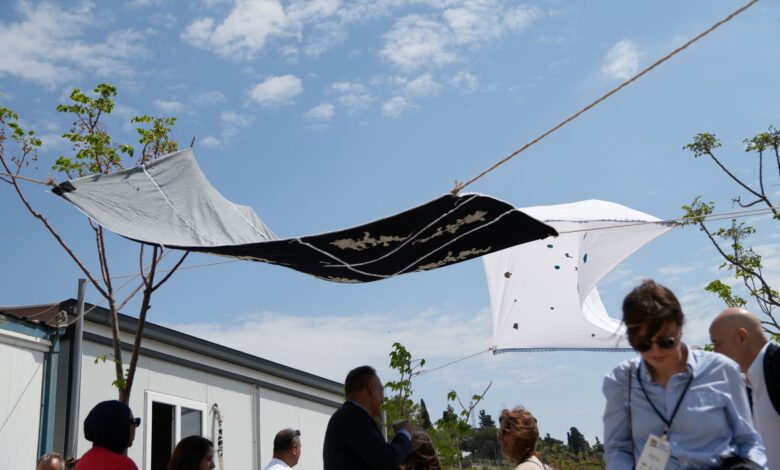
In the low-income neighborhoods of Pazaryeri and Imariye, climate resilience took the shape of hand-woven community canopies.
- The Strategy: Under the Climate Resilience for Communities project, local women led participatory workshops to identify severe heat paths. They designed, stitched, and assembled shading structures using recycled materials and textile waste.
- The Benefit: This ultra-low-cost, highly replicable model provided immediate physical relief from the sun while simultaneously driving social cohesion and boosting women’s leadership in neighborhood governance.
3. Policy and Toolkits: South Asia’s Regional Surge
South Asia is on the frontlines of climate vulnerability. Heatwaves that historically occurred once in a century are now expected once every five years across India, Bangladesh, and Nepal. ICLEI South Asia is converting this statistical urgency into municipal policy:
- Rajshahi (Bangladesh) & Nepalgunj (Nepal): Both cities established localized heat thresholds, mapped geographical hotspots, and launched multi-language Heat Action Plans tailored to business hubs where temperatures regularly cross 40°C.
- Rajkot (India): Partnering with the United Nations Environment Programme (UNEP) and the Cool Coalition, Rajkot became the first Indian city to pilot an Urban Cooling Action Plan, integrating passive cooling laws across all municipal departments.
- Surat (India): Developed a City Heat Resilience Toolkit alongside Taru Leading Edge, providing an actionable roadmap for neighboring municipalities to identify and prioritize heat-stress interventions.
4. Inclusive Refuges: Blacktown, Australia
In Western Sydney, Australia, summer temperatures routinely spike into the mid-40s Celsius. Blacktown City Council manages one of New South Wales’ fastest-growing and most culturally diverse suburban populations, representing over 180 different ethnicities.
Because generic emergency alerts miss residents facing language barriers or lacking home air conditioning, Blacktown integrated social equity into its heat defense:
- Social Infrastructure: The council partnered with the Red Cross to open localized “Cool Centres.” They are now upgrading long-standing civic hubs, like the Max Webber Library, into fully equipped heat refuges capable of supporting vulnerable populations during multi-day heat emergencies.
- Physical Trials: On the streets, the council is actively testing reflective cool-road coatings and urban canopy placement to lower ambient surface temperatures.
Comparative Matrix: Global Urban Heat Strategies
| City | Primary Mechanism | Scale / Type | Key Co-Benefit |
| Belém, Brazil | Climate Risk & Vulnerability Analysis (CRVA) | Municipal Policy | Unlocks international climate finance |
| Marseille, France | De-paving & 4,500m² micro-forest | Institutional / Tech | Reduces sewer overflow into the Mediterranean |
| Izmir, Türkiye | Hand-sewn waste-material canopies | Grassroots / Low-Cost | Boosts civic engagement and women’s governance |
| Rajkot, India | Urban Cooling Action Plan | Inter-departmental | Sets an institutional framework for the region |
| Blacktown, Australia | Library heat refuges & reflective roads | Socio-Structural | Protects linguistically diverse & vulnerable groups |
The Global Framework: Scaling the Effort
Urban climate action does not happen in a vacuum. Underpinning these individual city achievements are massive global networks designed to scale technical capacity and funding:
- The Beat the Heat Implementation Drive: Launched at COP30 by the UNEP-led Cool Coalition and over 80 partners, this initiative accelerates sustainable cooling deployment worldwide.
- The ICLEI-IFRC Cooperation Agreement: Formalized at COP28, this partnership between ICLEI and the International Federation of Red Cross and Red Crescent Societies combines municipal government power with community-level humanitarian reach.
“Cities are often acting ahead of national policy, and ICLEI’s role is to ensure their efforts are connected, recognized, and resourced.”
— Gino van Begin, ICLEI Secretary General
As extreme temperatures continue to shatter records annually, these five case studies show that urban cooling is no longer a luxury—it is a foundational pillar of modern city survival.
source:
https://talkofthecities.iclei.org/when-the-heat-rises-cities-act/