
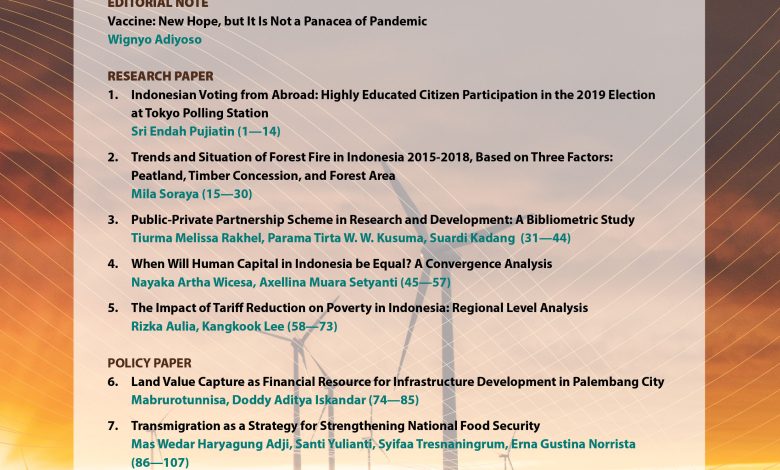
JISDeP Vol 2 No 1 (2021): April 2021
COVID-19 has been a major global health problem. As a pharmaceutical intervention had not yet been available, curbing the spread of COVID-19 has depended on the people’s protective behaviors. Although the governments throughout the world encouraged people to wear a face mask, adhere to social distancing, and wash hands using sanitizers, some ignored such a call (Adiyoso & Wilopo, 2020). Since vaccination has been rolled out to populations near the end of 2020, it instills a new hope for battling against COVID-19. However, the vaccine is not a panacea or end of the pandemic.COVID-19 vaccine has been available, yet it is limited. Vaccine development is essential, and past experiences have shown that vaccines save millions of lives. The race to find a safe and successful COVID-19 vaccine attracted people from all over the world. However, the complexity of COVID-19 virus has made vaccine development incredibly challenging. COVID-19 vaccines are produced to meet high quality, safe, and efficacy requirements as all other vaccines. The effects of COVID-19 vaccines are first tested in the laboratory, including on animals, before tried on human volunteers (WHO, 2021).According to WHO, at least seven different vaccines have been rolled out in some countries since February 2021(WHO, 2021). Vaccination is prioritized for vulnerable people in all countries. Vaccines create immunity to minimize the risk of getting a disease. Our body’s immune system reacts when we receive a vaccine. Every year, vaccines prevent 2-4 million deaths from diseases such as diphtheria, tetanus, pertussis, influenza, and measles, while around 200 additional vaccine candidates are being developed simultaneously (WHO, 2021). At the same time, a new variant of coronavirus has been discovered (Nikkeistaff writers, 2021).Vaccination is regarded as one of the most effective public health interventions, but some people believe it is dangerous and unwarranted. The concept of risk communication has explained why people neglect to protect themselves from such pandemic by taking the vaccine. Previous studies revealed that protective behavior is determined by complex factors such as demographics, the chance of getting victim, feeling severity, experiences, emotion, self-efficacy, and subjective norm (Dubéet al., 2013). In one place, for example, past experiences are the dominant factor in influencing people to take certain behaviors. In other populations, variables such as religions, gender, subjective norm, and trust in leadership may affect their behavior to take vaccines. Immunization is an indisputable human right and an essential part of primary health care. It is also one of the most cost-effective health investments (Dubéet al., 2013). Vaccination is one of the best and most effective public health strategies for keeping people healthy. In case of a COVID-19 outbreak, vaccines also will foster social and economic benefits. However, vaccine hesitancy does exist in the community. Understanding the factors that determine vaccine acceptance is crucial. It is needed to trace the historical, political, and socio-cultural contexts.
Source:
http://jurnal.pusbindiklatren.bappenas.go.id/lib/jisdep/issue/view/4


