
R-strategies for circular business models
Beyond Recycling: Embracing the 10R Framework for a Truly Circular Future
The vision of a circular economy extends far beyond the familiar blue bin; it demands a fundamental rethinking of how businesses operate. We’re talking about a systemic transformation in how products are conceived, brought into existence, and managed throughout their entire lifespan. Enter the 10R Framework, a powerful guide designed to help organizations navigate this complex yet crucial shift, offering ten distinct strategies to dramatically reduce resource consumption, amplify product value, and unlock unprecedented operational efficiencies.
Each “R” in the framework represents a distinct level of ambition and intervention, inviting companies to choose their entry point and scale their circular efforts.
The Upstream Revolution: Design for Impact (R0-R1)
At the pinnacle of circularity lie the most impactful, upstream strategies: Refuse (R0) and Rethink (R1). These aren’t about fixing problems after they arise, but about preventing them at the source.
- Refuse (R0): This is about consciously not creating waste. Can we eliminate packaging altogether? Is this product truly necessary, or can its function be achieved through a service? It’s a radical departure from traditional consumption.
- Rethink (R1): This strategy challenges the very business model. Can we shift from selling products to offering services? Instead of owning a washing machine, perhaps we subscribe to a laundry service. This reimagines how value is delivered, decoupling it from material ownership.
These are high-impact actions that tackle the root causes of waste and inefficiency, demanding a complete redesign of how businesses operate.
Extending Life and Maximizing Efficiency (R2-R3)
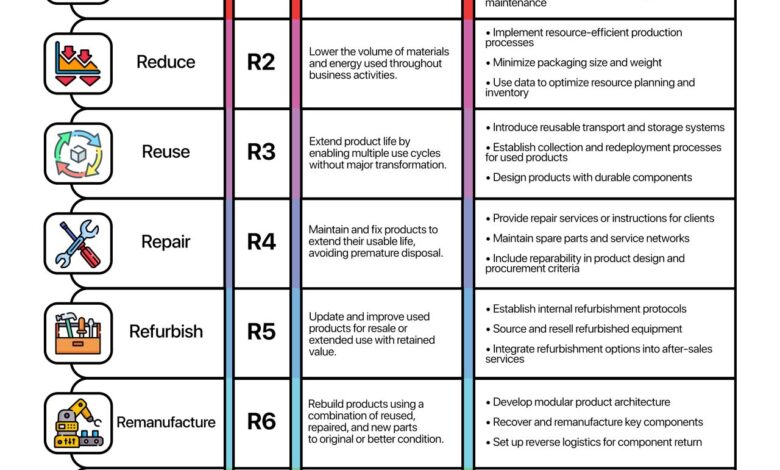
Moving down the hierarchy, we find strategies focused on operational efficiency and extending the life of existing products: Reduce (R2) and Reuse (R3). These are often more cost-effective and relatively simpler to implement, yet they deliver significant benefits.
- Reduce (R2): Simply put, use less. This involves minimizing material inputs in design, optimizing production processes, and streamlining logistics to cut down on waste.
- Reuse (R3): Keep products and components in circulation for as long as possible in their original form. Think refillable containers, returnable packaging, or second-hand markets.
These strategies directly translate into resource savings and increased product longevity.
Mid-Life Interventions: Value Preservation (R4-R5)
As products age, the Repair (R4) and Refurbish (R5) strategies come into play, offering mid-level interventions to extend their useful life.
- Repair (R4): Fix what’s broken. This encourages durable design and accessible repair services, shifting away from a disposable mindset.
- Refurbish (R5): Restore a product to a good working condition, often with minor upgrades, making it suitable for resale or continued use.
These strategies delay the need for new production, reducing environmental impact and opening avenues for new revenue streams and enhanced customer loyalty through extended product care.
Advanced Transformation: New Beginnings (R6-R7)
Taking value recovery a step further, Remanufacture (R6) and Repurpose (R7) involve transforming products or components for new or renewed functionality.
- Remanufacture (R6): Disassemble products, clean and inspect components, and reassemble them into “as new” products with warranties. This is common in industries like automotive parts.
- Repurpose (R7): Find a new use for a product or component that no longer serves its original function. For example, turning old shipping containers into housing.
These actions often carry more technical and logistical complexity but offer substantial value recovery and contribute to more resilient supply chains.
Last Resort: Recovery (R8-R9)
Finally, at the bottom of the hierarchy are Recycle (R8) and Recover (R9). While widely adopted, these should be considered as last-resort options when no other value-preserving strategies are feasible.
- Recycle (R8): Break down products into raw materials to be used in new products. This is energy-intensive and often results in some material degradation.
- Recover (R9): Extract energy from materials that cannot be recycled, often through incineration.
While necessary, these strategies generally deliver lower economic and environmental returns compared to the higher-level “R” strategies.
A Strategic Portfolio for Future Proofing
The true power of the 10R Framework lies in its ability to align core business priorities with circular principles at every stage of a product’s lifecycle. From eliminating waste at the source to recovering maximum value at the very end, each strategy provides actionable steps that companies can adopt based on their current capabilities and ambitions.
Implementing these strategies isn’t about embarking on a single, massive overhaul. It demands cross-functional collaboration, clear metrics to track progress, and a willingness to challenge ingrained, linear practices. It’s about selecting the right entry points, building momentum incrementally, and understanding that circularity is not a single action or a silver bullet solution. Instead, it’s a dynamic portfolio of interconnected strategies that, when applied consistently and strategically, can undeniably future-proof businesses while propelling us towards a truly sustainable future.
source:


